Announcing the Climate Justice Visual Arts Contest Winners
Today, EarthLab announced the winners of our inaugural UW Undergraduate Visual Arts Competition, celebrating unique artistic interpretations of environmental and climate justice. This contest encouraged University of Washington students across all campuses and disciplines to create art that reflects their perspectives on these critical issues. The competition aimed to elevate awareness of environmental justice, promote diverse student voices, and highlight the intersection of art, environment, and community.
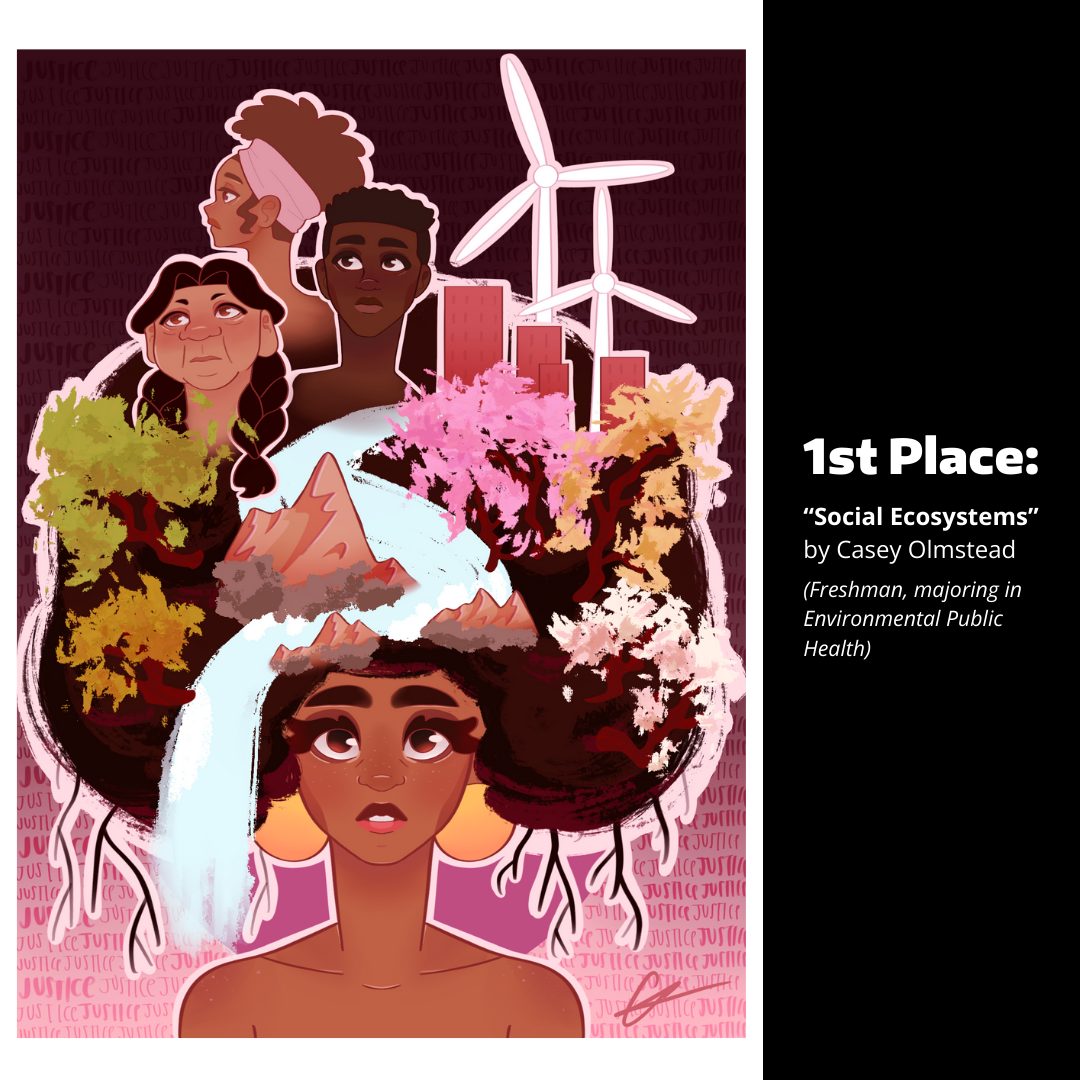
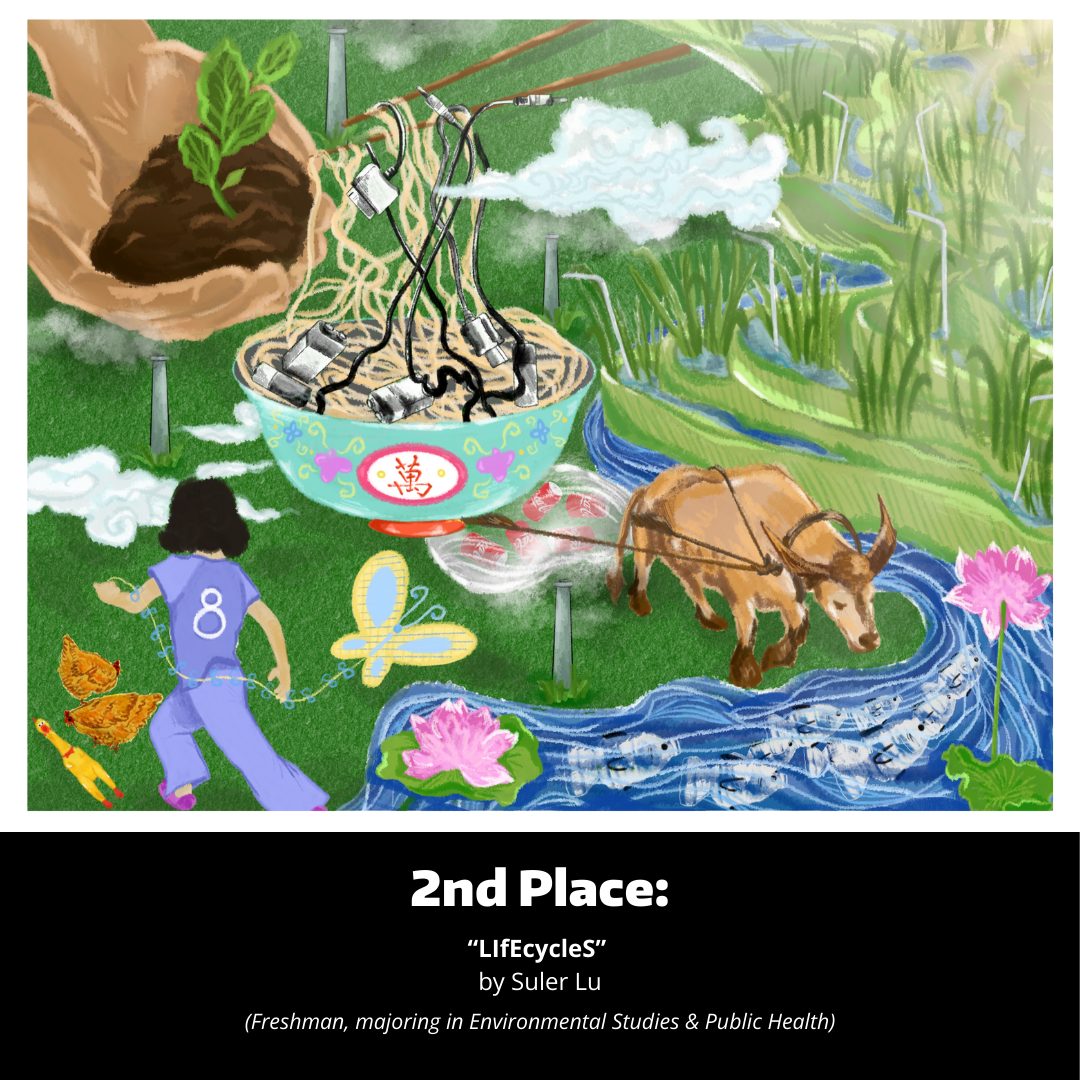
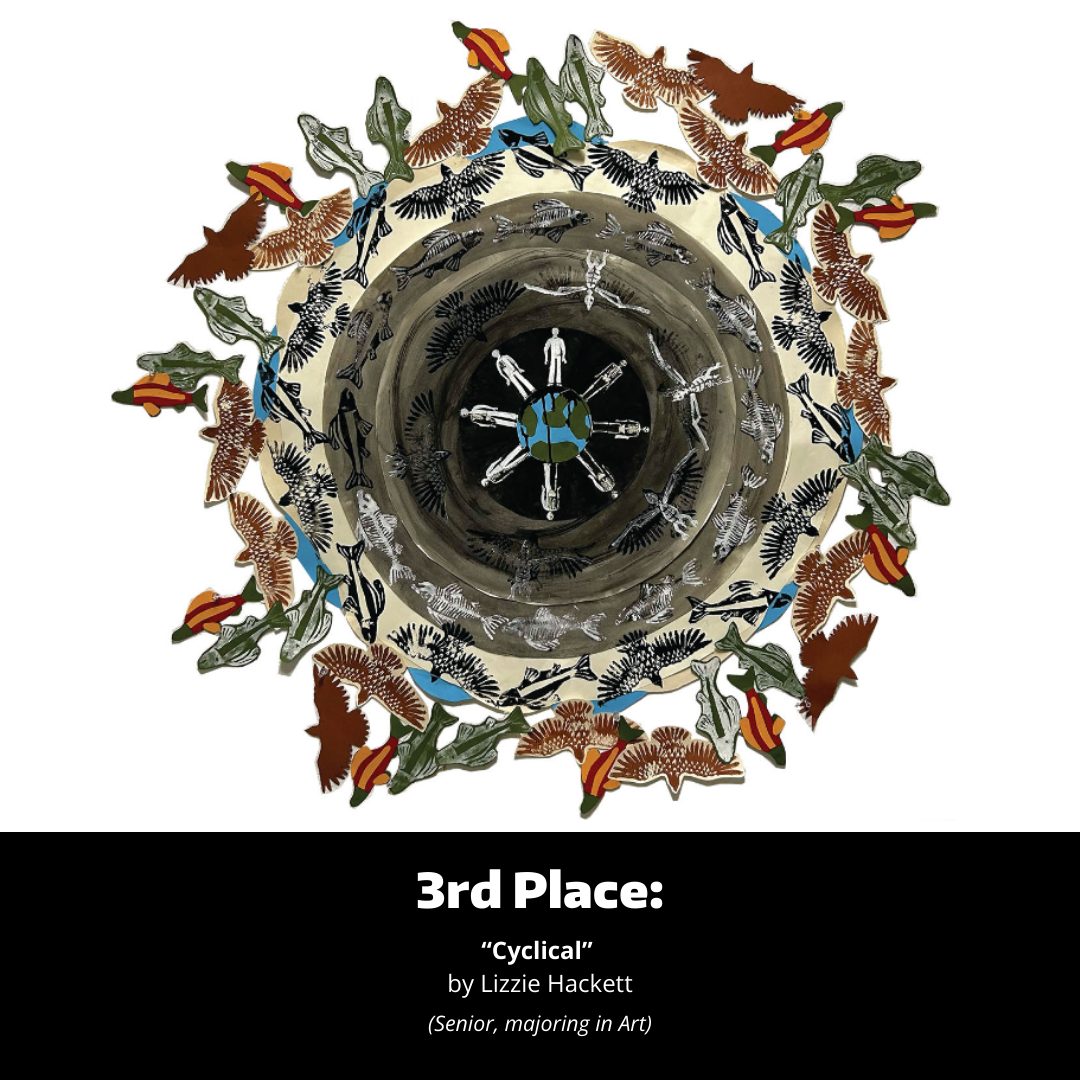
Casey Olmstead’s “Social Ecosystems,” which won first place, illustrates the resilience and activism of marginalized communities against environmental degradation. Suler Lu’s “LIfE cycleS,” awarded second place, critiques the global waste trade’s impact on non-western countries. Lizzie Hackett’s third-place piece, “Cyclical,” emphasizes the consequences of human actions on the environment and other species. The winning artworks will be displayed at EarthLab offices and select events, with Olmstead’s piece featured in an upcoming data visualization project. This contest has not only showcased student talent but also underscored the powerful role of art in communicating environmental justice.
Join EarthLab April 25 for Climate Justice Conversations and Connections

EarthLab presents an inclusive gathering focused on climate justice and community building. Across the Seattle, Bothell, and Tacoma campuses, University of Washington students actively engage in vital discussions about climate change and its profound implications for social justice. Now, we invite UW undergraduates from all campuses to unite for a transformative half-day event at the Husky Union Building.
 This free event is a platform for grassroots conversations to build a stronger climate community, where student voices take center stage. Through facilitated discussions grounded in principles of social justice and equity, we aim to ignite excitement and optimism for concrete next steps towards collective climate action at UW.
Join us to connect with peers and faculty, to exchange ideas, and to be empowered to drive meaningful change.
The event is flexible so arrive / leave when you can. See the agenda below.
Agenda
10-10:30 a.m. Welcome, land acknowledgement, setting norms – Breakfast
– Ben Packard, Executive Director, EarthLab
– Dianne Harris, Dean, College of Arts & Sciences
– Julia Parrish, Associate Dean, College of the Environment
10:30 – 11:15 a.m. Conversation 1: Group discussions
11:15-11:30 a.m. Break
11:30 a.m.-12:15 p.m. Conversation 2: Group discussions
12:15-1 p.m. Networking and student tabling – Lunch
FAQs
What is the goal of this event?
One of EarthLab’s goals is to connect people, ideas, and knowledge from across academic disciplines, sectors, communities and more to develop lasting and equitable solutions to climate change. While we’ve hosted several events for faculty to come together, we recognize that many students are leading this work, yet remain disconnected from each other and from UW academic leadership. EarthLab is committed to bridging that gap, understanding that this event will be the first of many efforts to do so.
Who is this event for?
This event is for any UW undergraduate student from any campus or major who cares about climate change and its relationship with social justice.
-Are you currently advocating for climate justice issues?
-Are you interested in learning more about climate justice, but don’t know where to start?
-Do you wish more faculty and deans on campus understood what students really care about regarding climate justice?
-If you identify with any of the above, this event is for you.
I’m a UW student, but not at UW Seattle. How can I attend?
We’re so glad you’re interested. If transportation is a hardship, please email earthlab@uw.edu and we’ll see what we can do. We’ve also included transportation options below.
-Transportation options from UW Bothell: To take public transit between UW Bothell and UW Seattle, Take 372 U-DISTRICT STATION EXPRESS
-Transportation options from UW Tacoma: To take public transit between UW Tacoma and UW Seattle, first take 594 Seattle to Stop 99254 @ Sodo Busway & S Lander St (NB) then transfer to the 1 Line on the Light Rail.
-Plan your trip with Metro Trip Planner
I’m not an undergrad. Can I come?
Faculty, graduate students, and staff who are interested in helping us facilitate the event are welcome, please email earthlab@uw.edu to learn more.
I can’t make the whole event. Can I still come?
Yes! We know three hours is a lot to ask for one day, so we’ve structured the event to coexist with class schedules. Stop by for one conversation, lunch, or all the above. By connecting with us now, you’ll be the first to know about future climate justice-focused events.
What will happen at the event?
Here’s the plan:
-After introductions, setting group norms, and breakfast, we will host group discussions on a variety of climate justice topics that are most important to you.
-You will self-select which discussion to join and meet peers from across academic disciplines and communities to better understand how this issue connects with your work, study, and life.
-Together, you will decide on important take-aways from the discussion that will be shared with the larger group and, eventually, with the EarthLab Board of Deans – a group of 13 deans committed to supporting EarthLab’s vision for an equitable, just and sustainable world where people and planet thrive.
-After two rounds of discussions, we’ll reconvene the group for a networking lunch, where student groups are welcome to share flyers and information about their work and you can continue making new connections while breaking bread.
UW EarthLab Announces 2024-25 Innovation Grants Projects for Climate & Social Justice
UW EarthLab awards $400,000 to develop actionable research at the intersection of climate change & social justice, making a positive impact on people’s lives and livelihoods
March 28,2024
Today EarthLab announced that five community-centered teams have been selected for the 2024-25 Innovation Grants program. Each team will receive $80,000 to research and develop new and actionable knowledge on community-driven projects at the intersection of climate change and social justice. To date, EarthLab has awarded nearly two million dollars in Innovation Grant funding to 29 transdisciplinary teams across five cohorts.
The Innovation Grants Program invests in collaborations that span academic disciplines, engage multiple sectors and center community questions that are taking equitable action on climate change. This year, 33 teams submitted letters of intent to apply to the Request for Proposals (RFP), of which 12 full proposals were submitted. Proposals were evaluated by a 10-member review committee that included faculty and staff from several disciplines and community partners from outside of the university.
Winning project teams include faculty from a range of disciplines at the University of Washington, including environmental & forest sciences, landscape architecture, civil & environmental engineering, French & Italian studies, marine & environmental affairs, international studies, global health, architecture, management & organization, and more. Partners from beyond the university include Tribal leaders and communities, city governments, community organizers and other universities.
“One of the greatest challenges for addressing climate change in my community is finding partnerships to conceptualize and materialize solutions,” shared Leydiana Menacho, Community Lead for the project Healing Amazonian Soils with Science and Indigenous Artisanry: Implementing Community-Based Composting System in the Urban Amazon. “I believe the EarthLab grant provide[s] us with the opportunity to consolidate a team and the support needed to refine and implement our ideas to introduce composting systems in the Amazon for the benefits of our ecosystems and people.”
In addition to the funds awarded, Innovation Grant recipients receive administrative and communications support throughout the eighteen month award period. All teams are part of our fifth grants cohort, which are workshop-style meetings designed to share resources on interdisciplinary and community-engaged research, create the opportunity for co-learning and networking, and to provide a structured space to work collaboratively on their projects. Final products intended to make a positive impact on people and communities are due by September 25, 2025.
Learn more about the Innovation Grants program here and check back often for news regarding the Cohort 1, Cohort 2, Cohort 3 & Cohort 4 funded projects.
This Year’s Funded Projects