EarthLab News
EarthLab Welcomes Program on Climate Change to EarthLab Affiliates
EarthLab announced today that the Program on Climate Change (PCC) has become an EarthLab Affiliate Organization. EarthLab Affiliates are University of Washington-based organizations that are similarly seeking to address critical and complex environmental issues. EarthLab and Affiliates support each other’s programs by sharing information, ideas and networks in order to catalyze new relationships and research projects.
Read more
Washington Commissioner’s Climate Summit Highlighted Area, Global Vulnerabilities
Dr. Amy Snover of the Climate Impacts Group was a key speaker at the Washington Commissioner’s Climate Summit. National insurance publication Insurance Journal covered the event.
Read more
Accelerating our global response to a worsening crisis
UW’s new Hans Rosling Center for Population Health asked five of the University’s leading voices on climate change and decarbonization to discuss how we can move forward from the pandemic in ways that deliver environmental resilience and positive health outcomes for all.
Amy Snover, director of the Climate Impacts Group and university director of the Northwest Climate Adaptation Science Center, contributed to the series with the following essay.
Read more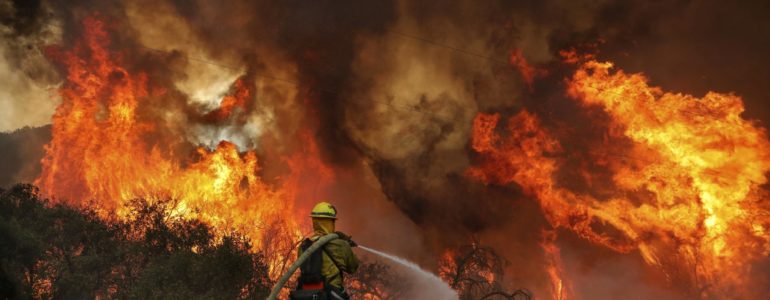
We Need Unity and a Multifaceted Approach to West's Wildfires
Crystal Raymond Ph.D. is a climate adaptation specialist with the Climate Impacts Group at the University of Washington EarthLab. She has conducted research on fire science and climate change for more than 15 years.
Read more
Climate Impacts Group Scientists Tapped for Expertise on West Coast Climate Fires
As multiple fires on the West Coast devastate towns and fill the air with toxic smoke, people are looking for answers. Multiple regional news outlets have relied on experts from the Climate Impacts Group to provide clarity into the current situation and hope for the future.
Read moreEarthLab Innovation Grant project selected as a finalist for a "Science Breakthrough of the Year" award at Falling Walls 2020
We are pleased to share that one of our inaugural Innovation Grant projects was selected as a finalist for a "Science Breakthrough of the Year" award by the Falling Walls Conference, an annual world forum for leaders across sectors and disciplines to come together to discuss pressing global challenges and answer the question, "Which are the next walls to fall in science and society?"
Read moreNew Online Resource for Mental Health Professionals to Find Events Related to the Psychology and Psychotherapy of Climate Change
When we think of the impacts of climate change, we often think of how the crisis is worsening environmental degradation or threatening the health of communities. For mental health professionals, climate change is affecting their practice as well, as they work to serve the growing number of people who feel grief, anger, despair, anxiety and other emotions because of the climate crisis.
Read moreNew NW CASC Synthesis Explores the Effects of Climate Change on Invasive Species in the Northwest
There is growing concern that changing climate conditions will amplify the negative impacts of non-native invasive species and facilitate their expansion. This study highlights how little we know about how climate change has or will affect aquatic and terrestrial species in the Northwest, especially at the fine geographic scales needed to manage them.
Read more
Climate Jam: Exploring solutions for a rapidly changing world
EarthLab is a proud co-supporter of Climate Jam, a virtual event that brings game developers and creators together from around the world to take action and raise solutions.
Read more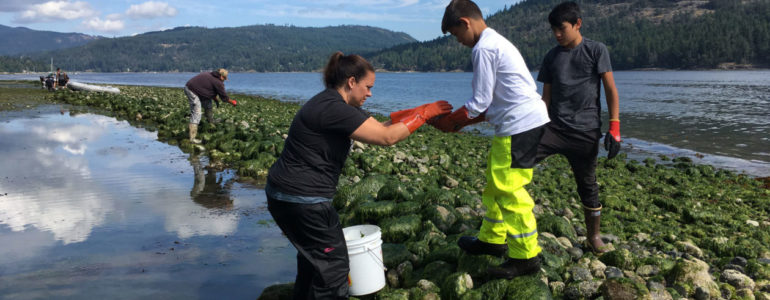
How Native Tribes Are Taking the Lead on Planning for Climate Change
For thousands of years, the indigenous peoples of the West Coast would build rock walls at the low tide line, allowing sand to pile up behind them, making the slope of the beach gentler, and expanding the area of the intertidal zone that clams like to call home. These simple clam gardens are effective at boosting shellfish numbers, and have long been used to improve food security for traditional peoples.
Climate Impacts Group's Meade Krosby was quoted in this article from Yale Environment 360.
Read more