EarthLab unveils new paid summer internships for UW undergrads
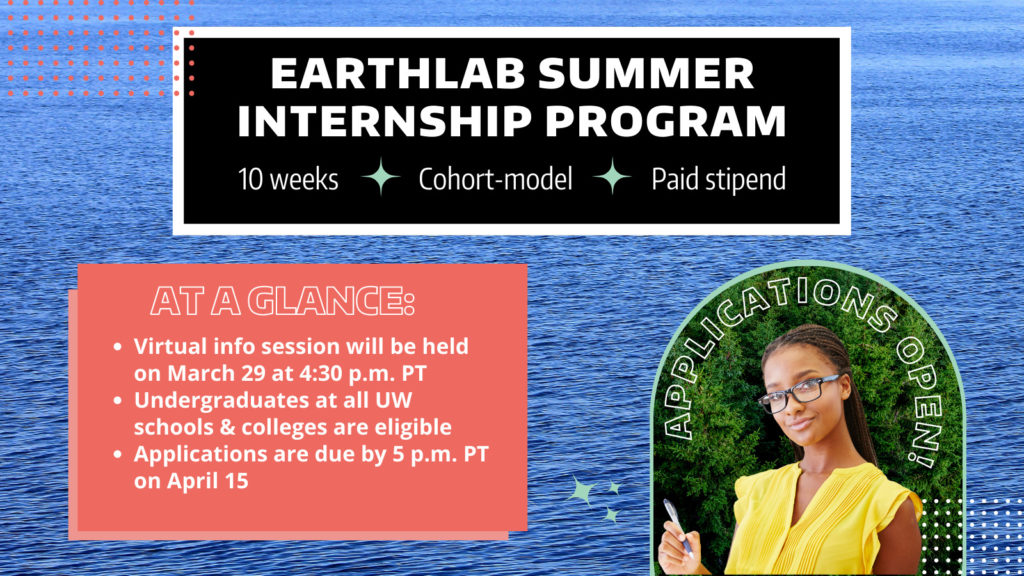
EarthLab has announced a new paid summer internship program for University of Washington undergraduate students who are passionate about addressing challenging environmental issues. Currently enrolled students (as of Spring 2022) from all UW schools, colleges and campuses are eligible to apply by 5 p.m. PT on April 15, 2022.
This year’s program will run for 10 weeks between June-August, with student presentations expected in the fall. Internships will be hosted within EarthLab member organizations. Although each project is unique, interns will engage with and learn from each other while attending required training sessions and other group activities. Each student will be provided with a faculty or research scientist mentor and will receive a weekly stipend based on the hours required for the project.
“We know that if we are going to effectively and equitably address environmental issues, we must rethink how we train the next generation of leaders, researchers and scholars,” said Ben Packard, EarthLab’s executive director. “We’re excited to offer this new opportunity for undergraduate students to build capacity for interdisciplinary, community-engaged environmental work.”
EarthLab is offering a live information session over Zoom on March 29 at 4:30 p.m. PT. Anyone interested in learning more about the program is encouraged to attend and ask questions. The session will be recorded and shared on the EarthLab website.
While the available projects span a variety of subjects, experiences and time commitments, students may apply to more than one project. They should note that many opportunities will require some remote work and some in-person work, following all safety protocols. The number of hours per week include required mentor meetings, group discussions and professional development trainings hosted by EarthLab.
2022 placements include:
Center for Health and the Global Environment (CHanGE)
- Climate Health Risk Tool Intern (15 hrs/week)
- Grant Application Support Intern (15 hrs/week)
- Northwest Climate Resilience Collaborative (NCRC) Intern (30 hrs/week)
- Green Schoolyards Project Intern (30 hrs/week)
- Forest Bathing Research Assistant (40 hrs/week)
- Indigenous Wellness Research Institute (IWRI) Intern (20 hrs/week)
Washington Ocean Acidification Center (WOAC)
- Ocean Literacy Intern (15 hrs/week)
- Ocean Acidification Intern (25 hrs/week)
- Zooplankton Diversity Intern (40 hrs/week)
Contact earthlab@uw.edu with any questions.
UW authors in IPCC report emphasize threats to human health and well-being
Two University of Washington experts in climate change and health, Kristie Ebi and Dr. Jeremy Hess from CHanGE, are lead authors of the latest report from the Intergovernmental Panel on Climate Change (IPCC). The new report titled Climate Change 2022: Impacts, Adaptations and Vulnerability, published Monday morning, details in over three thousand pages a “dire warning” about the consequences of inaction on reducing the emissions that are causing our planet to warm and on implementing interventions to prepare for and effectively manage the dangerous impacts of climate change already occurring.
A New House Bill is a Step Towards Signing CASCs into Law
As climate-related challenges unfold with increasing speed and impact, the Climate Adaptation Science Centers (CASCs) are hard at work delivering science to help our nation’s fish, wildlife, water, land and people adapt to the changing climate.
Salish Sea providing a ‘window’ into the future of ocean acidification
The Washington State Department of Fish and Wildlife (WDFW) is currently studying whether crabs could be impacted by ocean acidification, a process some scientists say Puget Sound is particularly susceptible to. Alex Gagnon, a researcher with the Washington Ocean Acidification Center, discusses the science behind greenhouse gasses, ocean acidification and the important crab industry in Washington state. (KING 5)
The Journal of Climate Change and Health: Hope, Health, and the Climate Crisis
How do health professionals acknowledge the climate crisis and its connections with human health? Howard Frumkin, a member of UW Nature and Health, published an article in The Journal of Climate Change and Health that offers ways for health professionals to consider hope as a path forward for themselves, their patients and future generations.