U.S. research funding on health effects of climate change inadequate
Although changes in the Earth’s climate are already harming the health of millions of people in the United States and abroad, the federal government is spending little on research on how to address the health effects of climate change, a new study concludes.
“We’ve systematically underinvested in this rapidly emerging health threat, and it has hamstrung our ability to respond,” said Dr. Jeremey Hess, professor of environmental and occupational health sciences at the University of Washington School of Public Health and of global health and emergency medicine at the UW School of Medicine in Seattle, one of the authors of the paper.
The paper appears in the current issue of the journal Health Affairs.
Hess wrote the paper with co-authors from Harvard University, Stony Brook University, Yale University, and the University Health Network in Toronto, Ontario, Canada. Dr. Cecilia Sorensen, director of the Global Consortium on Climate and Health Education at Columbia University, was the paper’s lead author.
n the study, the researchers determined the amount of research funding the U.S. government provided to outside organizations, such as universities and research institutes, from 2010 to 2020 to specifically address the health effects of climate change. Such extramural grants make up the vast bulk of U.S.-funded scientific research.
The authors of the Health Affairs paper found that during this 11-year period, the federal government funded only 102 grants that addressed the health outcomes associated with climate change. The total amount provided added up to just $58.7 million, or roughly $5.3 million per year.
For comparison, the U.S. National Institutes of Health, just one of the federal agencies included in the study, awarded more than $33 billion in grants just in 2022. The NIH has published information about its grant funding on its website.
“Less than $60 million in more than a decade is a minuscule investment for a problem that is expected to have a global impact within the next few years on the scale of the HIV/AIDS pandemic,” Hess said.
The researchers noted that ten climate-related disasters in the United States in 2012 alone were estimated to had led to more than $10 billion direct and indirect costs. In addition, the health effects of fossil fuel-related air pollution is estimated to cost the U.S. $820 billion a year.
Hess, who is an emergency medicine physician at UW Medicine, says the impact of climate change is already apparent in the nation’s emergency rooms.
“Emergency care providers provide care to everyone, anytime, for anything, so we see what’s prevalent in our area, particularly among vulnerable populations,” Hess said.
“In the Northwest, we are seeing a very clear signal of climate change with illnesses due to heatwaves, wildfires and wildfire smoke,” he said, while in other regions of the country healthcare providers are seeing a rise in injuries due to increased strength and frequency of storms and a rise in infectious diseases, such as malaria and dengue. The impact abroad is even more dramatic,” he noted.
The study’s authors call for more grant funding to support efforts to develop effective healthcare and policy interventions that will minimize the health risks and reduce health-related economic impacts of climate change, especially those affecting vulnerable populations and marginalized ethnic and racial groups.
“We need to invest in research to understand who is being highly affected by climate change and how to protect those in these vulnerable communities,” Hess said.
“While more funding is needed to understand how climate change affects health, we already know enough to start focusing now on identifying and evaluating interventions and how to implement those interventions effectively,” he continued.
“In many areas, we know what to do about climate change, but we need to move things along much more quickly than we are moving now,” Hess added.
“Lastly, we need to invest in training,” Hess said. “We support our Ph.D. and postdoctoral students through research grants and when there are no research grants available, we can’t train people.
Currently, we don’t have many people trained in climate change and health, it’s a particular skill set and because we haven’t invested in this area, we don’t have the researchers and practitioners we need.”
Now Open (plus more funding!) 🌟 EarthLab Innovation Grants
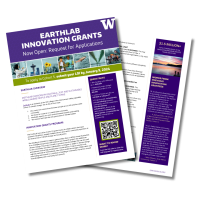
We’re excited to announce the EarthLab Innovation Grants Cohort 5 Request for Applications (RFA). The EarthLab Innovation Grants Program invests in collaborations of community members and UW researchers and students to co-produce actionable science and knowledge at the intersection of climate change and social justice.
NEW THIS YEAR: The maximum funding request is now $80k over 18 months & previously awarded grantees are allowed to apply for new projects.
Letters of Intent are due Jan. 9, 2024 at 5pm PST. Applicants invited to submit a full proposal will be notified on or before Jan. 30, 2024. Full proposals are due Feb. 27, 2024 at 5pm PST.
Walla Walla Student Team Fuels Environmental Community Impact with BioNova
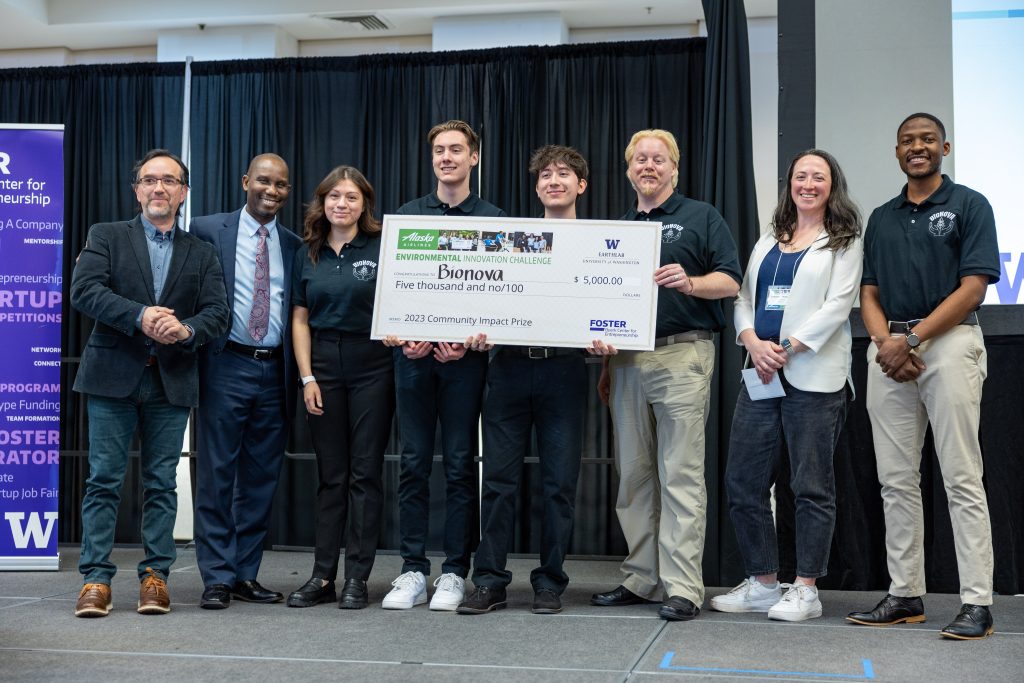
An international and multidisciplinary team of students from Walla Walla University is developing a new biogas production process for clean, affordable and sustainable energy. Team BioNova was the recipient of the $5,000 EarthLab Community Impact Prize at this year’s Alaska Airlines Environmental Innovation Challenge hosted by the UW Foster School’s Buerk Center for Entrepreneurship. More than 100 cleantech entrepreneurs, innovators, and investors reviewed 21 business plans in the final round and awarded nearly $45,000 in prizes in the 15th year of the competition.
BioNova’s innovative coated nylon bag design breaks down animal waste to create fuel that can be used for cooking or in generators. While other methods of producing biogas require large investment and are still expensive to the end user, the BioNova bags are low cost and lightweight. Their production model and connections to the carbon credit market will ensure clean fuel at a fraction of the current rate. The team stood out on its commitment to community impact through thoughtful partnerships with NGOs in Zimbabwe and Tanzania to address community needs for stable employment, clean energy and economic empowerment for women.
Their first bioreactor will be deployed in Ludewa, Tanzania this year. Congratulations to the WWU Team: Mark Wilber, MSW; William Elloway, Computer Science; Nyasha Pazvakawambwa, Business; George Perez, Psychology & Marketing; Takudzwa Pazvakawambwa, Business.