Athena Bertolino awarded for outstanding community impact
The UW College of the Environment awarded Athena Bertolino, Future Rivers program manager and member of EarthLab core team, the 2024 award for outstanding community impact. The Awards Committee was impressed with the breadth and depth of Athena’s work and the impact that she has, which was highlighted in her nomination letters. Her nominators note that she is absolutely essential to the success and impact of Future Rivers; she is completely dedicated to making the UW and College of the Environment a world leader in transdisciplinary environmental science research and education; her extraordinary commitment to excellence; and her ongoing commitment to diversity, equity, inclusion and justice through programs, trainings and continuous improvement opportunities.
Scientists want to know how the smells of nature benefit our health
Knowing more about nature’s effects on our bodies could not only help our us, but could also improve how we care for land, preserve ecosystems and design cities, homes and parks. Yet studies on the benefits of contact with nature have typically focused primarily on how seeing nature affects us. There has been less focus on what the nose knows, and that is what Dr. Gregory Bratman (director, Nature and Health) wants to change.
Apply today to the EarthLab Summer Internship Program
 Ready for a summer that’s more than just a break? Immerse yourself in the EarthLab Summer Internship Program! This isn’t your typical summer gig—it’s a paid stipend opportunity for any current UW undergrad from any discipline or campus that is currently enrolled as of Spring 2024.
This year, we’re offering 16 placements with EarthLab member organizations and our colleagues at The Nature Conservancy and Puget Sound Institute for a dynamic 9-week experience. In the spirit of learning and growing together, we’ve developed a collaborative cohort-model to meet with your peers for weekly dialogues, which complements the access to an assigned staff, faculty, or research scientist mentor at your individual internship site. Each project site will host different types of interdisciplinary and community-engaged experiences, all of which are taking equitable action on climate change. Interns will receive a paid stipend that is regularly disbursed over the 9 week internship, plus a $180 total travel stipend.
The best news is that we’ve simplified our application process! No cover letters required, just answer a few short answer questions and share a PDF of your resume.
Learn more about the program or sign up for a virtual info session below.
Taking hopeful action for win-win climate change and mental health policies
The connections between climate change and human health are becoming clearer with each new smoky summer, extreme heat dome, rising sea and migrating infectious disease. While the focus to-date has largely been on physical health, there’s a growing body of evidence that shows mental health is worsening as the global temperature rises. From depression and despair to anxiety and aggression, communities around the world and close to home are at risk, with frontline communities—most often communities of color, Indigenous, and low-income—continuing to experience the most immediate and worst impacts of climate change.
Despite these extreme challenges, there are actions we can take now to chart a new course for ourselves and for future generations. While some might interpret this statement as blind optimism, EarthLab is leaning in with hope and equitable action on climate change. As Mx. Pattie Gonia said to the New York Times at Climate Week, “Gloom is a very inspiring motivator in the short term. It’s not an inspiring motivator in the longer term. This is not some toxic positivity movement. This is ‘hey, we know the problems are real.’ So are the solutions, right? Right.”
It is with this spirit of hopeful action that EarthLab was honored to be invited by the OECD Wise Centre and the UW Environment and Well-Being Lab to co host a public workshop dedicated to better understanding the connection between climate change and mental health and the policies we can develop to improve lives. We were galvanized to reach across our connections at the University of Washington and throughout the region to elevate the voices and experiences of tribal nations and communities and the research and expertise of academics and practitioners.
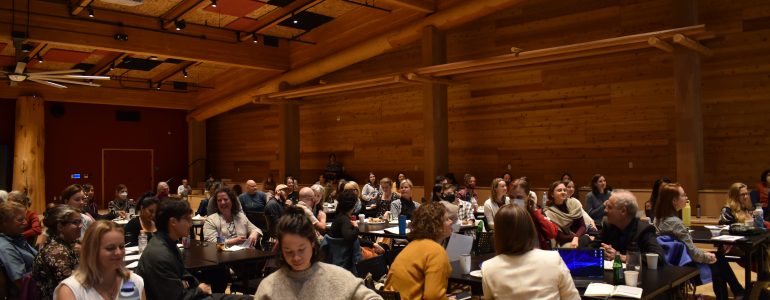
Altogether, fifteen panelists came together on September 19, 2023, for what became “The Climate-Mental Health Nexus: How a Well-Being Approach Can Provide Lessons for Win-Win Policies.” Together, they uncovered the complex pathways linking climate change and mental health, hopeful actions led by community, tribal knowledge, and barriers and successes in local, state and national policy. We are extremely grateful to our co-planners, speakers and the over 80 attendees for their time and enthusiasm to come together across disciplines, sectors and communities on this important topic. Please continue reading to learn more about the event and our speakers.
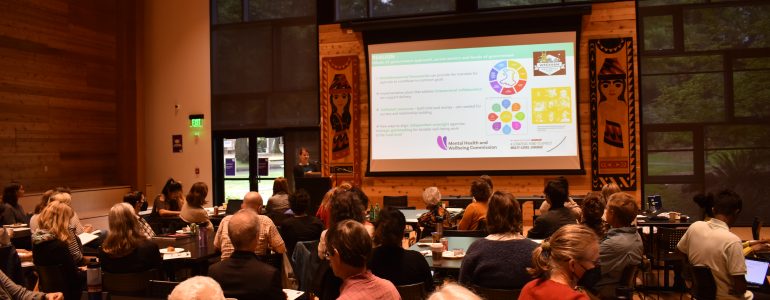
Climate & Mental Health Nexus: How a well-being approach can provide lessons for win-win policies
September 19, 8:45 AM-12:45 PM
Intellectual House, University of Washington
The event uncovered the complex pathways linking climate change to worsening mental health outcomes, including new forms of distress. It will also showcase the restorative and protective aspects of nature, and the ways in which climate action can be leveraged to promote positive mental health outcomes. Throughout, voices from community organizations working at the forefront of climate change mitigation efforts will be showcased. The event concludes with a policy discussion to consider the ways in which government at all levels – local, state and national – can identify success factors to promote the design and implementation of cross-sectoral policies.
Watch the full video now or view individual sessions below!
Welcome: EarthLab and OECD WISE Centre
Speakers:
Constance McBarron, Communications and Engagement Manager, EarthLab
Jessica Mahoney, Policy Analyst, OECD WISE Centre
Lara Fleischer, Acting Head of Unit, OECD WISE Centre
Keynote: How climate change & mental health are intricately linked and what this means for supporting climate action. [Remote address]
Speaker:
Emma Lawrance, Mental Health Lead & Climate Cares Lead, Imperial College London
Session 1: The interlinkages between mental health, nature and our changing climate
This panel session will describe the ways in which mental health and the natural world are related. It begins with brief framing remarks from the moderator, noting how time spent in nature is a protective factor for mental health, before segueing into two sets of panel discussions that touch on how climate change is affecting our mental health. Specific phenomena that are particularly relevant to the local area are highlighted, to provide concrete examples of how mental health is being hurt by these environmental changes.
Speakers:
Jamie Donatuto, Community Environmental Health Analyst, Swinomish Indian Tribe
Nicole Errett, Co-lead, Public Health Extreme Event Research Network
Olivia Hill, PhD Candidate, UW Environment & Well-Being Lab
Savannah D’Evelyn, Postdoctoral Scholar, UW Pacific Northwest Agricultural Safety and Health Center
Gregory Bratman, Director, UW Environment & Well-Being Lab
Session 2: Climate hope & taking action
This panel session will focus on the co-benefits of nature-based solutions for our physical and mental health. Hope founded on pathways, data and direction: what are those pathways, backed by evidence? Knowing the many risks and costs of climate change to our well-being, how can we move beyond hopelessness and paralysis to spur policy action? What does the evidence base tell us about pathways to hope – how to identify them, and encourage action.
Speakers:
Terrell Engmann, Co-Director, Basilica Bio
Howie Frumkin, Senior Vice President and Director, Land and People Lab, Trust for Public Land
Aurora Martin, Co-executive Director, Front and Centered
Alana Quintasket, Vice Chair, Swinomish Indian Tribe
Session 3: Policy solutions for healthy people & planet
The event will end with a roundtable discussion specifically focusing on the role of local, state and national policy makers in building mental resilience and community preparedness to threats brought about by climate change. The discussion should be process focused: what are the barriers to multi-sectoral action on climate change and mental health? What are success factors, and how can they be implemented? Rather than a recap of existing programs, a reflection on why those programs worked, how they were funded, and the extent to which they are self-sustaining. Ideally the discussion will end with key take-aways and lessons learned.
Speakers:
Renée Bouvion, Region 10 Regional Health Administrator, U.S. Department of Health and Human Services
Jamie Judkins, Project co-lead, Centering Place and Community to Address Climate Change and Social Justice
Colin Maloney, Community Health Strategies for Homelessness, Washington State Department of Health
Elise Rasmussen, Climate and Environmental Justice Associate, City of Seattle