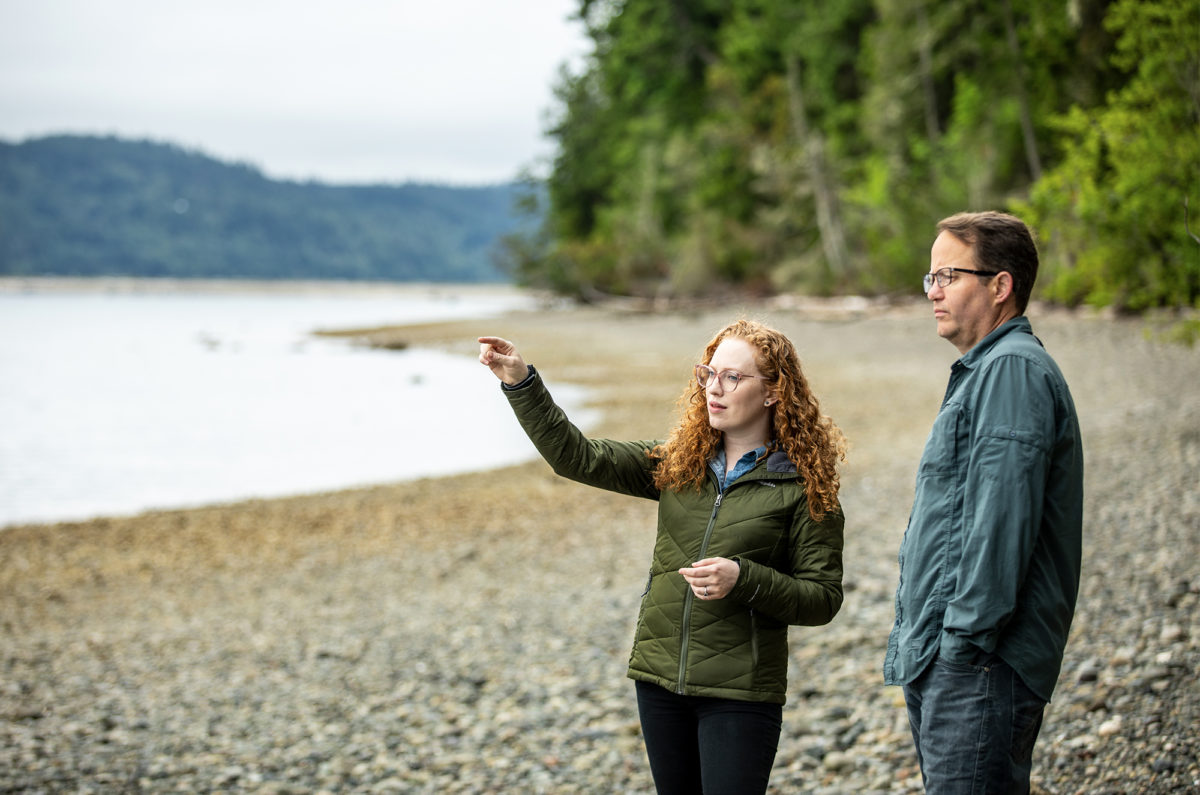
From early childhood classrooms to prescribed fire surveys, UW-led teams will advance environmental work across the country.
May 19, 2026
Twelve University of Washington research teams will receive funding through EarthLab’s Grants Program, the organization announced today. The Incubator Grants and Rapid Response Grants — both launched in February 2026 — mark the first expansion of the program since 2019.
These two new programs grew out of insights from researchers and community partners over five cohorts of Innovation Grants: that their work often begins before traditional funding cycles can respond. Some partnerships need a convening, a workshop, or a shared question to gather around. Some data collection windows open and close in weeks. The Incubator and Rapid Response programs were built to meet both needs.
“We are excited to support this cohort of projects, which exemplify the creativity, collaboration, and urgency needed to address today’s environmental challenges,” said Amy Oakley, grants program lead at EarthLab. “These grants support the kind of cross-cutting, impact-driven work that defines EarthLab’s mission—connecting science, people, and practice to create solutions that matter now.”
“What we kept hearing from researchers was that the work often starts before the funding does — in a conversation, a crisis, a community asking a question that can’t wait,” said Phil Levin, EarthLab interim executive director. “These two programs are our attempt to meet researchers where they are, at whatever speed the work demands. Seeing this first cohort come together, we’re reminded that climate and environmental justice research looks like a lot of different things, and we want EarthLab to be expansive enough to hold all of it.”
This year, 12 teams submitted letters of intent for Rapid Response Grants, of which four were awarded. For Incubator Grants, 32 teams applied and eight were selected. Proposals were reviewed by a committee of UW faculty.
Rapid Response Grant Awardees
Rapid Response Grants fund urgent, time-sensitive data collection that addresses emerging climate change or environmental justice questions. This year’s four awardees are working in places where the window for gathering data is narrow — and where the findings will matter to communities, practitioners, and policymakers for years to come.
- Exploring Prescribed Fire Perceptions in Washington State | Francisca Santana, Assistant Professor, School of Environmental and Forest Sciences
- Addressing Community Concerns About Contamination in Wildfire-Impacted Lahaina | Melanie Malone, Associate Professor, School of Interdisciplinary Arts & Sciences
- Connecting the Dots: Community, Climate, and Energy Resilience on the West Coast | Katie Arkema, Affiliate Associate Professor, School of Marine and Environmental Affairs
- Emerging Patterns in Permit-Exempt Groundwater Wells and Washington’s Streamflow Restoration Act | Philip Womble, Assistant Professor, Evans School of Public Policy & Governance
Incubator Grant Awardees
Incubator Grants operate as seed funding to nurture ideas and launch partnerships for climate change or environmental justice research and action. This funding supports the slower, relational work that research depends on, but funding rarely covers: the convenings, partnerships, and shared agendas that make ambitious future projects possible. This year’s eight awardees are building that infrastructure across a wide range of settings and communities.
- Symposium on Climate Change, Preparedness, and Health in Carceral Settings | Rachel Sklar, Assistant Professor, Environmental & Occupational Health Sciences
- Developing an Indigenous Data Sovereignty Agreement User Guide | Jamie Donatuto, Clinical Associate Professor, Environmental & Occupational Health Sciences
- Building a Heat Mitigation Retrofit Framework for Public K-12 Schools in Washington State | Amos Darko, John E. Schaufelberger Endowed Assistant Professor in Construction Management, College of Built Environments
- Leveraging Regional Expertise to Address Youth Mental Health, Climate Change, and Environmental Justice | Jennifer Atkinson, Teaching Professor, School of Interdisciplinary Arts & Sciences
- Pursuing Collaborative Adaptation in Coastal Washington | Celina Balderas Guzmán, Assistant Professor in Landscape Architecture, College of Built Environments
- Rooted Knowledge: Land Stewardship, Storytelling, and Social Justice | Matthew Randolph, Assistant Professor, American Ethnic Studies
- Expanding the Innovation and Impact of Engagement Methods with Overburdened Communities | Cory Struthers, Assistant Professor, Evans School of Public Policy & Governance
- The Natural Start Alliance Research Network: Building Research Infrastructure for Early Childhood Climate Resilience and Environmental Justice | Gail Joseph, Professor, College of Education
For full project descriptions, visit earthlab.uw.edu/grants.
About EarthLab EarthLab is an institute at the University of Washington College of the Environment taking equitable action on climate change. The EarthLab Grants Program cultivates a community of faculty, staff, students, and partners united by a commitment to community-engaged, impact-driven climate and environmental justice research and action. Learn more at earthlab.uw.edu.
Media Contact Allie Long Communications Lead, EarthLab alongs@uw.edu