Funded Projects
Connecting the dots with data: community, climate, and energy resilience in US West Coast counties
About the project:
Power outages along the West Coast are increasing in frequency and duration due to aging infrastructure, extreme weather, and rising demand. These outages disproportionately affect vulnerable communities, compounding health risks, food insecurity, and cultural resource loss. By collecting and synthesizing outage data, social metrics, and storms, we provide actionable insights for resilience planning and transmission development. This work moves beyond traditional metrics to focus on long-duration events and county-level disparities, revealing risks that standard utility reporting obscures.
Cultivating Transdisciplinary Support for Equitable and Resilient Floodplains
Project Update
November 2023
The goal of our project is to convene a transdisciplinary team to co-define potential research directions that aim at supporting equitable and resilient floodplain management in the lower Nooksack River floodplain. Our team includes one student in landscape architecture (Camille Forest), three community representatives, and seven academics with expertises ranging from political ecology to anthropology to civil engineering.
Cultural Ecosystems in a Changing World: Building a Network Across the Northwest to Support Food Sovereignty, Climate Adaptation and Land Rights
Awarded Project Overview
April 2022
About the Project:
Indigenous communities worldwide are on the frontlines of climate change, facing disproportionate impacts due to historical and ongoing marginalization, land theft, and environmental degradation. In the Pacific Northwest, cultural ecosystems—such as clam gardens, forest gardens, and camas prairies—have sustained Indigenous food systems for millennia. These ecosystems not only provide food and medicine but also offer climate-adaptive benefits, like increased biodiversity and carbon sequestration.
Developing an Indigenous Data Sovereignty Agreement User Guide
About the project:
The project will develop a user guide to support ethical, respectful, and effective research and data sharing partnerships between Indigenous communities and external partners. It will collate and review existing Indigenous data sharing agreements to identify shared principles and best practices, with attention to data sovereignty, governance, consent, cultural protocols, and community priorities. Based on this review, the guide will outline practical steps, key questions, and sample components to help partners create transparent, accountable, and locally responsive agreements.
Digitizing Holistic Environmental Stories
Complex, multi-spatial, and temporal environmental-societal problems are common and challenging to resolve since they persist for decades. Unresolved, history has shown us how societies are pushed to a tipping point and may collapse following unusual weather events. While available data has enabled us to discern broad environmental trends, our current models and decision frameworks continue a narrow, fragmented and disciplinary-based approach that increases the risk that societal and/or environmental collapse are likely to occur in the future.
Read moreDoes Vegetation Help Mitigate Roadway and Aircraft-Related Air Pollution in Seattle? A Community-Engaged Study Using Drones For 3D Air Quality Measurements
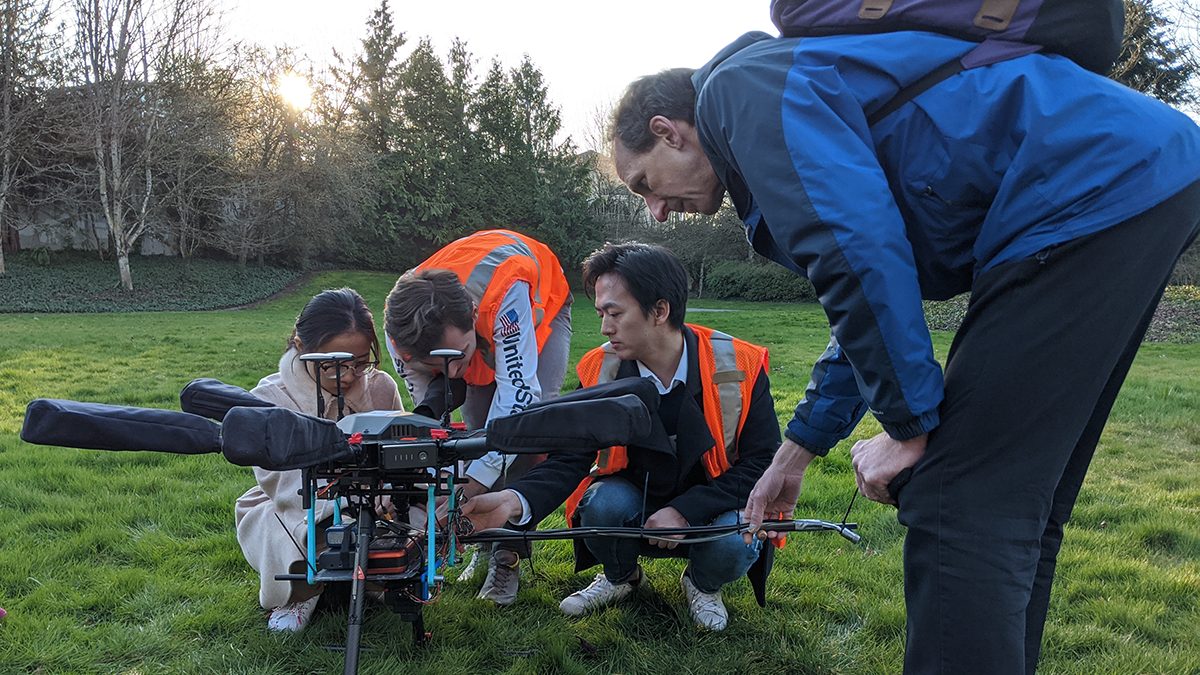
A Community-Engaged Study Using Drones For 3D Air Quality Measurements
Recent UW research that has identified high concentrations of ultrafine particle air pollution in some Seattle/King County communities has created an urgent need to evaluate the potential efficacy of community-scale air pollution mitigations, including the role that vegetation may play in reducing air pollution. Few studies have considered how trees and shrubs affect ultrafine air pollution, and most have focused on reductions in particles in the horizontal direction to the side of freeways from roadway traffic particle sources, rather than the distributions of particles in vertical and horizontal directions relevant to both roadway and aircraft-sourced particles.
Emerging Patterns in Permit-Exempt Groundwater Wells and Streamflow Offsets Under Washington’s Streamflow Restoration Act
About the project:
Concern that new groundwater wells were reducing water availability for fish and other water users led to the Washington Supreme Court’s 2016 Hirst decision, which halted rural homebuilding reliant on permit-exempt wells. In response, the 2018 Streamflow Restoration Act allowed new wells while aiming to offset their impacts and investing $300 million in river restoration. Here, we aim to join practitioner interviews with a new statewide geospatial dataset linking permit-exempt wells and offsets to document emerging implementation patterns as key legislative reporting approaches in 2027.
Environmental and Human Health Impacts of a New Invasive Species in Madagascar
2020-21 Project
In 2005, the marbled crayfish (Procambarus virginalis) appeared for the first time in lakes, ponds, and streams of Madagascar. Once limited to the area around the capital, the crayfish’s range now encompasses an area of 100,000 km. The project team is interested in the multifarious environmental and human health impacts of this new invasion.
On one hand, Madagascar is a biodiversity hotspot with a diverse, endemic freshwater fauna that could be affected by this invasive species, and with a large population of rural, poor people whose diet staple is rice, an agricultural product that might be endangered by non-native crayfish.
Ethnoforestry: Applying Traditional Ecological Knowledge for Ecosystem Sustainability on the Olympic Peninsula
2019-20 Project
Across the Olympic Peninsula, widespread changes in forest management policy have altered rural communities over the last several decades. Many rural communities were hit hard by a decrease in available jobs due to a decline in timber supply from over-harvesting and spotted owl protections as well as mill modernization. Tribes have since suffered from a decline of some cultural keystone species adapted to early seral conditions precluded by efficient tree regeneration and late-seral reserves.
Expanding the Innovation and Impact of Engagement Methods with Overburdened Communities
About this project:
Washington State has invested in innovative community engagement methodologies such as “community assemblies” to engage overburdened (frontline) communities experiencing environmental injustice. Assemblies bring together members of these communities to (1) increase civic capacity of participants and (2) change policy (e.g., programs, legislation, budgets, procedure) to meet community priorities. This project converts research findings on community assemblies to concrete strategies that can be used to improve assembly design, focused on fostering government action after engagement.