Now Hiring: EarthLab Assistant Director for Finance & Administration (Full-Time)
Are you someone who gets excited by the creative problem-solving that comes along with leading an organization’s financial, human and physical resources team? Do you have a passion for connecting your work to environmental and social justice issues? Apply today to be the next EarthLab Assistant Director for Finance & Administration!
Who we are:
EarthLab is an institute at the UW College of the Environment taking equitable action on climate change. We do this in four ways:
- We create new connections between people across UW and the wider community
- We invest in research co-created with community
- We build capacity for more environmental research and training
- We mentor and train the next generation of climate leaders
We’ve got big ideas for the future, which you can learn more about in our strategic plan. This will give you a solid understanding of our vision, mission and goals for the next several years. We think it’s worth perusing to help you better understand what we do.
Still with us? Great! Now here’s what we’re looking for:
EarthLab is seeking a full-time Assistant Director for Finance & Administration to manage EarthLab’s money, people, and physical resources.
This is a unique leadership role that makes sure everything runs smoothly for EarthLab and its member organizations, which includes around 70 people. Their goal is to make sure the resources from the University of Washington and their partners are used wisely to meet the growing need for current and future EarthLab programs.
The Assistant Director for Finance & Administration plays a crucial role in making sure EarthLab scholars, staff, faculty, and students can bring their creative ideas to life and jump on new opportunities. They handle the practical side of things – like money and resources – with a flexible and creative approach. In turn, this helps everyone at EarthLab collaborate on innovative projects and partnerships. The Assistant Director for Finance & Administration also comes up with guidelines for career growth, perks, and other ways for faculty, staff, and students to get involved in EarthLab’s mission, all of which help make EarthLab an awesome place to be and an exciting partner to work with.
This leadership role needs someone who’s great at getting along with others and making sure everyone’s voice is heard through a collaborative approach. They need to be smart about managing people and money, and they’ll have to make important decisions on their own. The Assistant Director for Finance & Administration guides their team in handling all sorts of issues, whether they’re related to contracts, finances, admin, or personnel.
Now a little bit about you:
In order to thrive in this unique role, we’re hoping that you’re an independent decision-maker with an entrepreneurial spirit. You will be a crucial part of bringing innovative projects and partnerships to life by rapidly responding to new opportunities through your administrative and financial management acumen. As part of the EarthLab management group, you will also have the chance to help chart the course for a highly collaborative, start-up environment, which requires being involved in leading an organization that is new, visionary, and undefined. Reporting to the Executive Director and leading a team of three, you’ll have many opportunities to both collaboratively develop and independently manage a comprehensive set of complex administrative, contract, financial and personnel issues.
Salary range:
$8,500 – $10,000 per month
The culture you’ll be joining:
We acknowledge the systemic racism that exists in the environmental sector and within environmentalism at large. At EarthLab, we believe every member on our team enriches our diversity by exposing us to a broad range of ways to understand and engage with the world, identify challenges, and to discover, design and deliver solutions. If you are committed to helping us create an equitable, diverse and inclusive work environment where all voices are considered and valued, we want to hear from you.
NextGen Narratives | Climate Challenges, Collective Solutions: The Story Behind Beating the Heat
By Caitlin Soler
Storytelling for Social Change Intern, Summer 2023
When we think of climate change in the Pacific Northwest, environmental impacts are increasingly at the forefront of our minds: raging wildfires, flooding, and breaking weather records. Two years ago, the Pacific Northwest Heat Dome broke heat records in cities across Washington, Oregon, Idaho, California, and Nevada. In many places, temperatures were 30 degrees above the seasonal average; Seattle alone measured 107°F.
Less remembered were the melting roads, scorched crops, and packed cooling centers. By the end of the heat dome, over 250 people died in the U.S., primarily due to preventable heat illness and exposure. Events like the heat dome remind us that the impacts of climate change are not just environmental.
In reality, climate change is deeply tied to our economy, infrastructure, public health, social justice, and more. While we sometimes acknowledge these impacts separately, we rarely consider them all together. Talking about the effects of climate issues in siloes limits our understanding of the scale and depth of these problems impacting both people and the planet. To effectively build resilience in our changing climate, we first need to start thinking of more preventative responses we can take now so that we can create more expansive narratives for sustainable future change.
For example, we often take a reactive approach to climate disasters, which means we wait to address problems as they occur or in the immediate aftermath of emergencies. But as climate disasters become more intense and unpredictable, this approach can leave frontline responders feeling underprepared.
During the heat dome, many frontline responders worked with limited resources and knowledge to react to the crisis, which exceeded expectations in its scale and impact. Some patients’ conditions were so severe that health professionals filled body bags with ice to cool people down. The experiences of these frontline responders highlight an urgent need to include preventative measures in our response to climate change.
Nearly two years after the heat dome, EarthLab, the Climate Impacts Group (CIG), and the Center for Health and the Global Environment (CHanGE) co-hosted a multifaceted event called Beating the Heat: Collective Action for a Safer Northwest, which highlighted how preventative action can create attainable and actionable steps towards climate change resilience.
The event centered around the launch of two new climate change resources. CIG’s latest report, In the Hot Seat: Saving Lives from Extreme Heat in Washington State, highlights how agencies, experts, communities, and individuals can enact short- and long-term risk reduction solutions for extreme heat. Around the same time as this report’s release date, CHanGE launched its newest interactive platform, the Climate Health and Risk Tool (CHaRT). This tool allows users to explore the relationship between climate-related hazards and climate, environmental, social, and economic factors. Seeing the possibility for greater impact by joining forces, EarthLab hosted Beating the Heat as a way for its member organizations, CHanGE and CIG, to showcase their work collaboratively.
Perhaps even more importantly, Beating the Heat granted these organizations the ability to connect not only with those in academia but the broader community. This in-person event welcomed over 80 transdisciplinary researchers, public-health experts, journalists, government officials, and community members interested in actionable recommendations for preventing future heat-related illnesses and saving lives.
EarthLab, CIG, and CHanGE sought to make Beating the Heat a collective event, highlighting various experiences during and after the heat dome. Recognizing that the issues around climate resilience have deeply affected people across Washington state, the event began with a panel of medical, local, and state experts external to UW who either work as or work with frontline responders during climate emergencies. Many panelists recognized that although underprepared for the heat dome, there are tools, resources, and actions we can collectively take now to build a better future together,
This summer event brought together policymakers, journalists, academics, healthcare professionals, students, and community members. It spoke to what Earthlab wants to accomplish: remove barriers between the communities within academia, build greater connections beyond the university, and make complex data accessible and actionable for everyone.
Solutions happen when we realize that lasting change comes from preventative resources and collective action around climate resilience. Beating the Heat was a great example of how we can do that.
Introducing NextGen Narratives, a fresh addition to the EarthLab news page, tailored for University of Washington students to express how they’re thinking about taking equitable climate action in a variety of ways. If you’re a student eager to join NextGen Narratives, don’t hesitate to contact Allie Long, EarthLab’s Communications Lead, at alongs@uw.edu.
Register Now for the Climate – Mental Health Nexus: How a Well-Being Approach Can Provide Lessons for Win-Win Policies
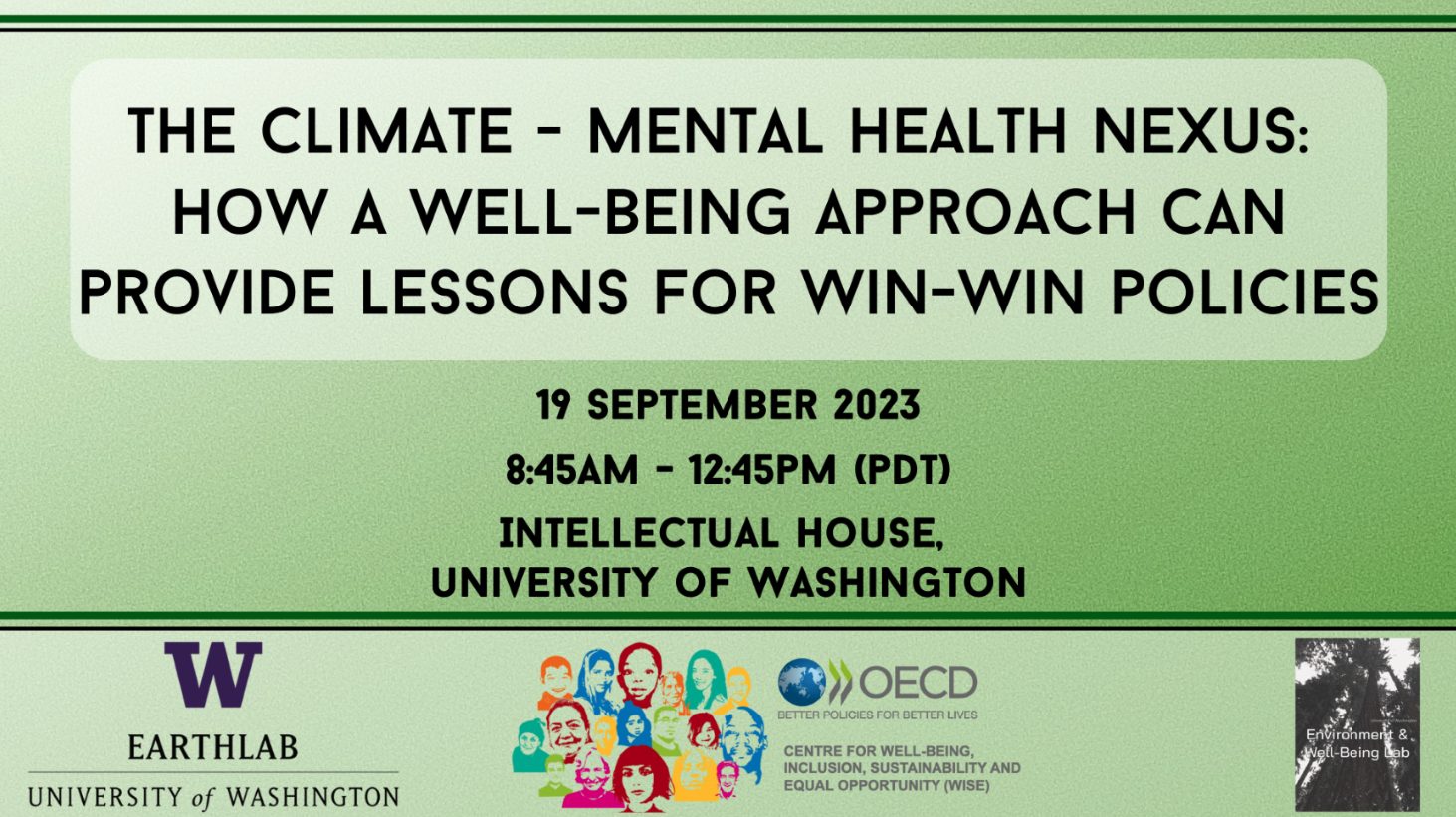
Join the University of Washington’s EarthLab, the Environment and Well-Being Lab and the OECD WISE Centre in a half-day public workshop on the intersection of climate change and mental health. The event will uncover the complex pathways linking climate change to worsening mental health outcomes, including new forms of distress. It will also showcase the restorative and protective aspects of nature, and the ways in which climate action can be leveraged to promote positive mental health outcomes. Throughout, voices from community organisations working at the forefront of climate change mitigation efforts will be showcased. The event concludes with a policy discussion to consider the ways in which government at all levels – local, state and national – can identify success factors to promote the design and implementation of cross-sectoral policies.
Introducing the CHaRT Tool: Navigating Climate-Related Health Risks
As climate changes continue to affect our lives, it is crucial for decision makers and community members to have the information they need to better understand and then address climate-related hazards. Certain communities bear a disproportionate burden from these hazards, which makes it essential to thoroughly understand the different mechanisms, scales, and geographic distributions of climate impacts on community health.
To address this, the Center for Health and the Global Environment has officially launched the Climate Health and Risk Tool (CHaRT), a groundbreaking interactive platform that helps users explore the intricate relationship between climatic, environmental, social, and economic factors contributing to hazards faced by communities. This tool integrates diverse elements such as climate-related risks, population exposure, and vulnerability to estimate the risks to communities effectively.
Users can explore previous heat-related risks through interactive modeling, whether it’s to learn more about what happened in Washington during the 2021 heat dome, or how different geographical locations in Washington State are typically impacted by climate-related hazards based on their region. With comprehensive guidance documents, the CHaRT tool can also equip users with the knowledge and strategies necessary to plan and prepare for future climate-related health risks in their respective communities, which is a crucial next step to safeguard community health amidst changing environmental conditions. By combining multiple community and climate measures, the CHaRT Tool empowers users to understand and characterize the hazards confronting their communities.

The CHaRT Tool operates within a robust conceptual framework based on the Intergovernmental Panel on Climate Change (IPCC) risk framework. This framework considers vulnerability, hazard, and exposure as fundamental components of risk assessment. By integrating these elements, the CHaRT Tool enables a comprehensive understanding of the complex interplay between climate and community health.
At its core, fuzzy modeling forms the backbone of the CHaRT Tool’s analytical capabilities. By employing a hierarchical structure, fuzzy modeling combines logical propositions to evaluate various climate and community characteristics. This approach facilitates nuanced assessments, allowing decision makers to explore critical questions and make informed choices regarding climate-related health planning. This approach also allows users to assess various factors, ranging from social and economic characteristics to specific hazards like extreme heat or flooding.
We invite you to explore the Climate Health and Risk Tool and leverage its powerful capabilities to address climate-related health challenges in your community. Together, we can foster resilience and protect the well-being of individuals and communities in the face of a changing climate.