UW initiative ‘Society + Technology’ aims to foster broad collaboration at critical intersection


Applications Now Open for Climate Equity and Resilience Summer Institute


Conserving and communicating on my own terms: My empowering (and muddy) summer as an EarthLab intern
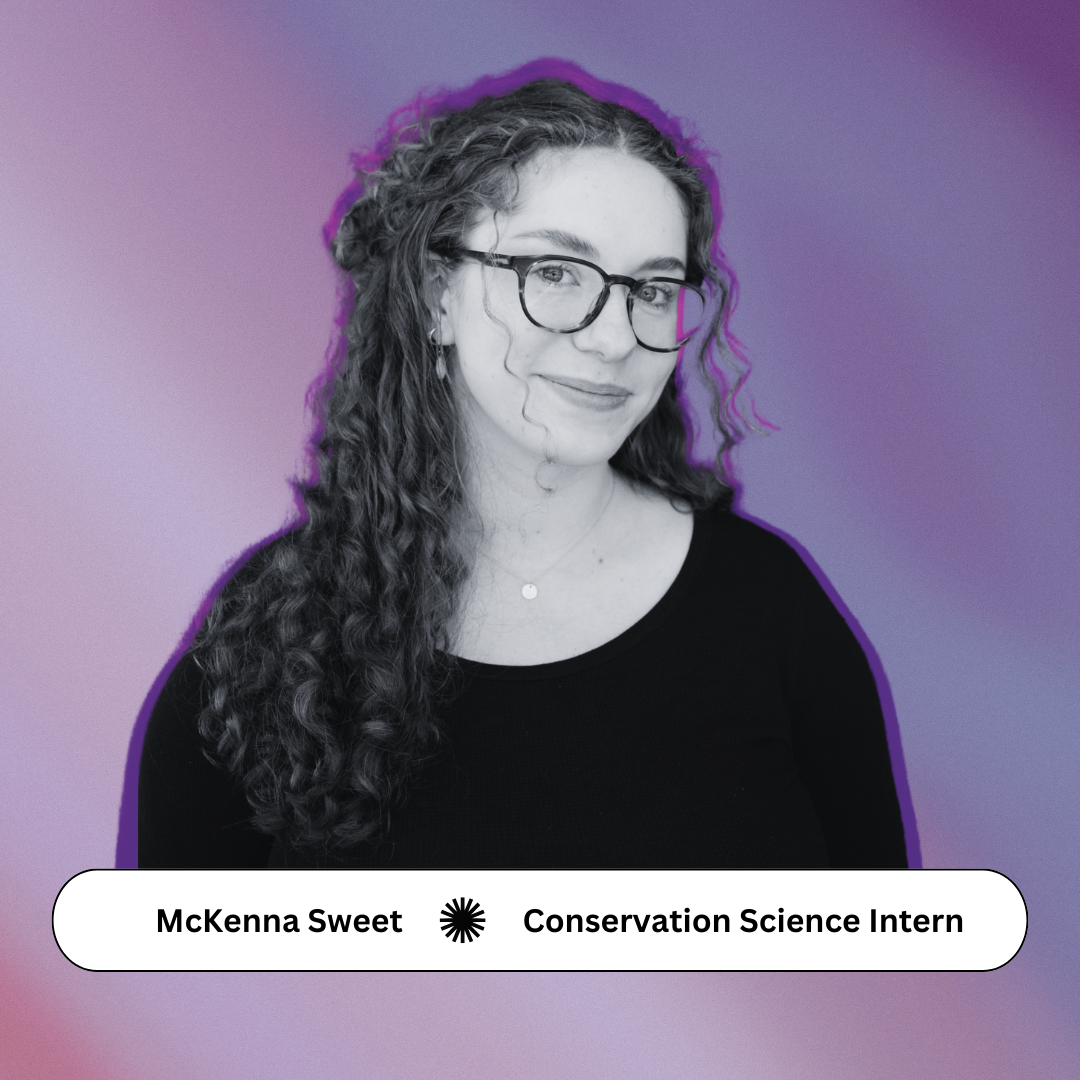
McKenna Sweet By McKenna Sweet
Conservation Science Intern, Summer 2024

I want to go into wildlife conservation. 

This is something I’ve known since my sophomore year of high school after watching an episode of Planet Earth II that highlighted the endangered Indri lemurs, who are endemic to Madagascar. This is also something I tell people when they ask what my majors are and what I want to do after I graduate.

However, despite laying out my loyalties to protecting non-human species and explicitly saying that I don’t immediately want to go into journalism, I’ve noticed that people still give me unsolicited job suggestions in the communication field instead of seeing how a communication background will support me as a conservation biologist. 

This happened at a happy hour for a conference where I was chatting with some folks from the National Oceanic and Atmospheric Administration who suggested a few communication openings they had after I said I wanted to pursue conservation. Another time, an academic advisor suggested I finish my journalism degree and maybe get into the Ecology, Evolution, and Conservation Biology major but not get my degree in it, even though I had made it clear that journalism was the on-the-side major for me, not biology.

I still don’t fully understand why this has been a reoccurring response. I don’t believe it’s malicious in any way, and I appreciate that people try to help by giving me options, maybe remembering the apprehension surrounding their post-undergrad job hunt. But I can’t help but feel that it has something to do that they just don’t see me – a woman – in a career that involves hands-on, muddy, dirty, manly work.

Today, the life sciences are mostly split evenly between men and women. However, a 2023 paper highlighted that women often experience challenges and barriers to fieldwork, such as harassment from colleagues, being discouraged from joining a survey, or being told they’re not strong enough for the work.

That’s why working with an all-woman team of conservation scientists and interns at The Nature Conservancy (TNC) through EarthLab this summer meant so much to me and reminded me that, despite what people apparently think, there are jobs I actually want to pursue in which I can succeed.

Part of my internship was doing fieldwork at Port Susan Bay and along the Stillaguamish River. The data collection was stinky, sweaty, and definitely not pretty, but the bulrushes and sticklebacks didn’t care if the waders I wore were flattering, and neither did the company. All that mattered to me was that the work felt fulfilling and I felt comfortable with the team.

While working, my supervisors shared difficulties they’ve faced with some men in the field, including some condescending engineers who seemed to only respect someone if they had a PhD. One of our guest speakers during the weekly EarthLab meetings talked about how much the STEM field has changed since she was our age, and it made me think about how many other women have had people suggesting careers they were apparently supposed to care more about. 

And I’m so glad these women didn’t listen!

After this internship, I was happy that it confirmed, once again, that I do want to pursue a career where I’m outside getting my hands dirty. I also helped create an Instagram post about beavers for the Washington TNC’s account where I used my science communication skills on my own terms. For conservation projects to succeed, there needs to be successful plain-language communication to ensure the public understands the gravity of the situation. 

Having two majors doesn’t mean that I’m confined to one of two separate careers, but rather it provides me with a sea of skills that transcend degrees and combine to prepare me for helping people and species in my future career. 

Communication and conservation can exist in my life at the same time, just like a woman can exist and thrive in fieldwork. There is a place for me and my femininity in what mostly is still a male-dominated field; I loved getting muddy, but I also hated being sweaty and curled my eyelashes every morning before trekking into the sulfuric-smelling marsh. 

I am OK with the fact that I’m more comfortable in waders and my purple floppy hat than I am in business casual – can you be OK with that, too?


NextGen Narratives is an EarthLab blog series tailored for University of Washington students to express how they’re thinking about taking equitable climate action in a variety of ways. If you’re a student eager to join NextGen Narratives, don’t hesitate to contact Allie Long, EarthLab’s Communications Lead, at alongs@uw.edu.


Turning the tide: Spotlight feature on Chris Mantegna, UW Student and EarthLab Innovation Grantee


NextGen Narratives | Building A Bridge Between Science and Lived Experience

By Caroline Hale
Climate Justice Academy Evaluation & Coordination Intern, Summer 2024

Caroline Hale, Climate Justice Academy Evaluation & Coordination Intern

I grew up very curious about the environment and the natural world around me; as I have grown, so has this curiosity. Questions that pique my interest include: what level of responsibility do we as humans have to protect the environment? What does protection even mean, and do some people carry more responsibility for environmental stewardship than others?

As I have explored these questions more deeply, I’ve learned that while we all have a relationship to the environment,  not everyone is equally impacted by environmental issues. This has made me consider the social justice implications of environmental challenges, which ultimately led me to explore an interest in climate justice work and research during summer 2024 through my internship position as the Climate Justice Evaluation and Coordination intern with the Climate Impacts Group (CIG).

My EarthLab Internship with the Climate Impacts Group (CIG)

This past summer, I was placed with CIG to assist the climate justice team in coordinating and evaluating the pilot year of their Science Justice Summer School. The summer school is a two week long interdisciplinary program offered to graduate students interested in learning more about climate justice and how to apply this knowledge to their prospective fields, such as economics, marine biology, or political science. The program discussed themes of settler colonialism, abolition, critical geographies, political ecology, detransitioning, maladaptation, Indigenous storytelling, and movement-building, to name a few. The days were filled with field trips, guest speakers, and walking tours, to make the experience as interactive and locally relevant as possible.

In preparation for the program, I conducted research to understand the current ways that programs like this one are being evaluated, and how to best evaluate graduate level students, a unique opportunity for me as an undergraduate. I wanted to incorporate a variety of mixed methods to evaluate the program to provide various engaging, and differing areas for students to share their experiences and feelings in a way that would be comfortable and conducive for each of them to share their feelings. 

The interdisciplinary nature of the program created an environment conducive to constructive conversations, as students proposed solutions and ideas that people with other niches had not yet considered. Through this process I learned that a large piece of being successful in my position was about being observant and receptive to the needs in the room. The goal of these evaluations was to get feedback from students from the pilot year of the program. That feedback data can be used to improve future iterations of the program by compiling information from students into a digestible evaluation report.

Spending My Summer with EarthLab

EarthLab, the engine behind my internship with CIG, is focused on pushing the boundaries in academia to reimagine how to take action against climate change while involving students, communities, and various disciplines.

Each week this past summer, I was exposed to an amazing lineup of guest speakers and the EarthLab team through their internship program’s cohort model. I had opportunities to collaborate with my peers and professionals, sharing ideas and diverse perspectives. Every intern had agency, and interns’ ideas were deeply valued and considered.

This internship program, dedicated to connecting students with one another, helped me build a network to help navigate unique and rising challenges. I have gained new perspective, motivation, and technique working and brainstorming alongside my peers with different areas of knowledge, interests, and unique educational and life experiences.

Looking Forward

Being a student in a changing and increasingly delicate world is certainly a tough role to navigate. Since coming to the University of Washington and pursuing an environmental studies degree, I have found myself experiencing an interesting phenomenon outside of school: older generations expecting young people to “save the planet,” while also not taking young voices seriously. My summer internship was an opportunity to experience the opposite.

The local work I did with CIG and EarthLab was a microcosm of larger global environmental justice initiatives. While scientific training is of course crucial to environmental work, at the same time, science is often not black and white. Rather, science exists within the context of the communities and power structures that influence it. Similarly, there are vast and important differences across various people’s lived experiences that impact the way we interpret facts and figures.

Looking back on my summer, I realized I am constantly surrounded by people who are experts in their own environments and experiences. Whether they were formally trained scientists, my peers, guest speakers, or the person I met at the Link station and started up a conversation with, everyone had something important and unique to share with me about their environment that sparked new considerations in my mind. This summer, I got to experience various ways of acquiring knowledge and getting educated, far beyond the Western standard.

What I learned is this: Everyone has a stake in environmentalism simply by being a person on this planet and having lived experiences. I truly believe that every individual has a place to share something unique and important about the environment. By listening to diverse perspectives and understanding the importance of scientific inquiry, we lay the foundation for effective climate solutions. Expanding our view of who can contribute to climate justice fuels the creativity needed for these solutions.

I want to be continuously learning. With that, the aim of this piece is to spark ideas and conversations. If you read this and have thoughts, I genuinely want to hear them! Shoot me an email cmh20@uw.edu.

Acknowledgements

I would like to thank the entirety of the EarthLab 2024 cohort, my fellow interns have inspired me beyond belief. Thank you to Allie Long for encouraging me to shoot for the stars and helping me write this blog. A big thank you to my mom, for your unwavering support and thoughtful guidance. Thank you to Lissan Tibebe, Ben Packard, and the rest of the EarthLab team for your continuous support through my journey. Finally, thank you to Rishi Sugla, Zack Thill, and the team at the Climate Impacts Group for hosting me as your intern this summer! 


Introducing NextGen Narratives, a fresh addition to the EarthLab news page, tailored for University of Washington students to express how they’re thinking about taking equitable climate action in a variety of ways. If you’re a student eager to join NextGen Narratives, don’t hesitate to contact Allie Long, EarthLab’s Communications Lead, at alongs@uw.edu.  


From Trash to Treasure: How the South Park Biodigester is Bringing New Life to the Community

By Allie Long

What if our garbage didn’t end up in the landfill, but instead could transform into something that was life-giving and helpful? Fortunately, for residents of Seattle’s South Park neighborhood, this idea has become a reality.

The Duwamish Valley Sustainability Association (DVSA), together with support from the South Park community, University of Washington’s EarthLab, the EPA, Food Lifeline, the City of Seattle, Seattle Parks Foundation, Sustainable Seattle, ECOnorthwest, NextCycle and 360 Social, has spent the last several years creating the first community-owned biodigester in Seattle. 

On October 11th, 2024, the DVSA team celebrated the biodigester’s opening week with colleagues and community members. After a brief introduction to the project, event participants were able to tour the biodigester, permanently installed in a truck bay at Food Lifeline

How it Works

Image of the biodigester opening celebration on October 11, 2024.
Executive Director Edwin Hernandez giving a live demonstration of how the biodigester works at the opening celebration on October 11, 2024.

A biodigester is a sealed tank system that works because the anaerobic bacteria inside of it breaks down our organic waste – like old banana peels, used coffee grounds, and the takeout in your fridge that’s definitely past its prime – because of the absence of oxygen. This process then creates valuable resources like biogas (which is a type of renewable energy) and digestate (which is a nutrient-rich probiotic plant food that can be used as a fertilizer); both of which communities can use to sustainably generate energy while simultaneously reducing greenhouse gas emissions. The result is a hyper-localized circular economy that transforms waste into a resource—by and for community.

Why it Matters

Imagine a future where neighborhoods own and manage their waste systems, using food scraps to support local food production, improve air quality, and provide renewable energy. The biodigester project is a small but significant step toward building that future, where communities have greater ownership over the resources they create.

The hope is that this project will not only reduce waste and generate clean energy but also build healthier relationships with what we consume and what we leave behind. “By converting food waste into a resource, we’re creating a cycle that keeps the benefits directly in the community: providing healthy food for local gardens, teaching youth about sustainable systems, and inspiring new ways of thinking about waste,” shared Edwin Hernandez.

Image of the biodigester getting installed in the Food Lifeline parking lot.
The biodigester was installed in the Food Lifeline parking lot on the evening of October 7, 2024.

Furthermore, South Park is one of the lowest ranking areas on the Health Equity Index in the state of Washington with a 10 out of 10 severity rating. This means that people living here face higher rates of pollution and greater health risks than other Seattle residents.

“If we give youth, especially in our Latino community, the tools and opportunities to discover new careers related to STEAM (science, technology, engineering, art, and mathematics), they could be the future professionals who replace those currently working at the EPA, King County, City of Seattle, and Boeing…and who also have knowledge of how to work harmoniously with their community and achieve results,” shared Hernandez in an interview with the UW Center for Environmental Health Equity.

This is why the biodigester is more than a piece of green technology—it’s a symbol of what’s possible when residents and partners come together to build solutions that work for everyone. By piloting this project in South Park, DVSA is laying the groundwork for a model that could be scaled up to other neighborhoods in Seattle and beyond.

This work is part of the Just Circular Communities Collaborative (JC3), an initiative that seeks to envision and implement localized, regenerative, and community-driven circular systems for a Just Transition – by, with, and for Frontline communities.

How You Can Support This Work

Image from DVSA biodigester's opening celebration on October 11, 2024.
DVSA Program Manager Todd Schindler giving a presentation about the biodigester at the community celebration on October 11, 2024.

In order for this project to be efficient and economically viable, the team is currently in the process of raising money to purchase a truck and a utility trailer to transport food waste from across the South Park community to the biodigester. If you’d like to donate to this funding goal, visit the Seattle Parks Foundation website here.

South Park’s small but mighty biodigester will be able to process roughly 200+ lbs of organic waste per day, which will turn into around 79 million Btu of heat energy in gas per year and 180 gallons/week of probiotic plant food to boost local crops.

With so many gallons of probiotic plant food available, the DVSA team is also looking for additional local partnerships that would be interested in picking up fertilizer on a regular basis to keep the processing running smoothly. If you know any local farms that would be interested in partnering with DVSA in exchange for plant food, please email DVSA’s Project Manager Todd Schindler.


Building Trust, Bridging Gaps: A Conversation with Ashli Blow on Science Communication & Environmental Justice

By Gabriela Palma
Storytelling for Social Change Intern, Summer 2024

Gabriela Palma, Storytelling for Social Change InternAs a recent graduate from the University of Washington with a degree in Communication and Environmental Health, my passion for science communication stems from a desire to learn about environmental health, share this knowledge with my friends and family, and address the gap between the scientific community and the public. 

Science communication is not just about articulating complex scientific issues; it’s also about making science accessible and encouraging people to be part of the solutions. While there has been remarkable progress, challenges still exist that create a divide between people and science.

This is why I was incredibly thrilled to have the opportunity to chat with Ashli Blow, one of the panelists who spoke to the EarthLab summer 2024 internship cohort about her journey as an established science communicator. Ashli is a freelance journalist focused on solutions-oriented journalism and recently graduated from the University of Washington with a Master’s in Environmental Policy from the Evans School of Public Policy and Governance. She also participated in the Future Rivers Program, a member organization of EarthLab. 

Q: How would you define science communication?

“If I had to define it, I would take a page out of my  incoming doctoral program at the University of Oregon that I’m going to at the Center for Science Communication Research. They talk about science communication as enhancing the conversation between scientists and society. So for me, it’s taking what scientists are doing and breaking it down for the public, and the “public” is a really vague term. Talk about definitions! But for me, that means your everyday person, politicians, educators, and having messages tailored in different ways that resonate with each of those groups. Not necessarily code switching, but adapting it for relevance of why it matters to different people.” 

Q: Do you remember the moment you decided that you wanted to write about environmental justice for the first time?

“During the pandemic in 2020, I was very homesick and paying attention to a lot of events happening back in Tennessee. I started reading about people who were virtually protesting a venture that wanted to put a crude oil pipeline through a historically Black community. That was how I realized I can no longer separate justice from what I’m doing with science communication. I’ve had to break off relationships with people in my field who don’t agree with that. But for me there is empirical evidence that shows you cannot talk about climate change without talking about environmental justice or climate justice.”


Ashli Blow, Freelance Journalist & PhD StudentQ: You just graduated from the UW Evans School of Public Policy & Governance with an MPA in Environmental Studies—congrats! What prompted you to go back to school, and how has this degree influenced the way you think about communicating environmental science and policy to your readers?

A: “Thank you! I actually thought for a minute I was going to stay in government work because I wanted to do policy analysis. In 2019, I took a brief break from journalism to work in Washington State’s Department of Natural Resources. The reason I went back to get my Master’s degree at UW was because I was being left out of certain conversations just because I didn’t have a degree. Then during the pandemic, a lot of structures in government were changing to try to meet the moment of COVID. Journalism was also really strained, and they needed support. Ultimately, I did go back to journalism while in school, and I’m really happy that that happened.

My Master’s degree has helped my journalism as well. For example, the Solutions Journalism Network just published my capstone project with the Evans School, which is called “Unpacking Climate Policy.” It’s a roadmap to help science communicators and journalists understand policy effectiveness to create climate solutions-oriented journalism. 

Being a journalist and working in communications professionally, I knew I had strong writing skills, but I wanted to understand how to look at numbers better and bring that to readers. You don’t have to be an expert in everything, but I do believe you need to know how to ask questions. So that’s what this degree ultimately did; it helped me think about better ways to ask questions about policy and science, especially when it comes to climate change. 


Q: How do you approach writing stories about communities whose lived experiences are overlooked? 

A: This is a tough question because I’m obviously a white woman. I feel like I have a responsibility with that privilege to not go in and extract and then tell the story to white people who have not had that lived experience. I think I have definitely done that kind of journalism, and it’s something that I strive to not do. Sometimes that means turning down stories because I’m not the right person to tell them, and then sharing that opportunity with journalists who do have that lived experience and want to tell that story

When it comes to communities that I have a connection to—like in Memphis reporting on the Black community—I still make mistakes and am learning all the time, but those are neighbors I grew up with. I also have to think about my own lived experience. Understanding it on an academic level and being a neighbor still doesn’t mean I understand what it’s like.

This is why my work is centered in relationships and trust. What I usually do is go to an advocacy group, tell them about climate issues I’m interested in covering, and if they have people who want to be amplified, then I’ll have a series of pre-interviews. So we both get to know each other and see if it’s a good fit for the person I’m interviewing. At any time, if they’re like, “You know what, this really actually isn’t right for me,” all I can do is respect that, which is different from what I was taught in my journalism school. I’m still unlearning some of those journalism practices that don’t work for my practice, but I think that’s an approach I have to take at a slower pace. It takes humility and patience in the same way as breaking news takes a kind of diligence. 


Q: You mention how some organizations are changing. What guidance do you have for students or early career professionals interested in pursuing science communication?

A: My best advice is to just get experience, and I’ll put an asterisk on that that I’ll get to in a moment. It’s important to get out there and see how the sausage is made. It might mean you’re doing science communication that you don’t necessarily love. For example, one of the projects I had was about cleaning up poop from waterways, and it was not glamorous, but it was a good experience.

The asterisk mentioned, for me, it was always a balance between accepting assignments for experience versus speaking up to start getting more work that I wanted that aligned with my values. That’s something that came with time. The caveat is don’t stay in an environment that is toxic just for experience. Find that baseline of safety for yourself and take care of your mental health. 


Q: We’re living in a polarizing time, politically, environmentally, and socially. What do you think about science communications’ role in combating misinformation and disinformation? And what gives you hope?

A: Yes, it plays a huge role! I think a facts-first approach covers you. When I worked at the Department of Natural Resources, talking about the need for wildfire funding, you have to present facts, not opinion. Going back to the science communication definition, if society can have a better relationship with science, then I think that combats misinformation and disinformation.

What gives me hope about all of this is going back to how journalism, in some aspects, is changing. That’s because of the people who are there. It’s people who are changing. There are people who have different perspectives and different lived experiences than journalists and communicators of the past. It is a reckoning journalism is having, and what you get with that is not just better science reporting, but that’s also where that justice piece comes in. People who have the experience or relationships with folks to go into communities on the front lines and talk to them in an authentic way that’s not extractive. I have a lot of hope for what that means for journalism and what society gains from science communication.


Introducing NextGen Narratives, a fresh addition to the EarthLab news page, tailored for University of Washington students to express how they’re thinking about taking equitable climate action in a variety of ways. If you’re a student eager to join NextGen Narratives, don’t hesitate to contact Allie Long, EarthLab’s Communications Lead, at alongs@uw.edu.  


EarthLab Releases First-Ever Impact Report, Showcasing Early Achievements and Future Aspirations

Image of person looking at laptop with EarthLab 2024 Impact ReportSeattle, WA – October 7, 2024

(Leer en español)

EarthLab, an institute at the UW College of the Environment taking equitable action on climate change, is proud to announce the release of its inaugural impact report. This document highlights EarthLab’s significant achievements from January 2021 – June 2024 and outlines its ongoing commitment to fostering innovative, equitable climate solutions.

“Releasing EarthLab’s first impact report is an honor that I share on behalf of all the community partners, staff, researchers, and students that make up our community,” shared Executive Director Ben Packard. “This document stands as a testament to the early progress we have made towards the ideas and hopes we identified in our strategic plan and it serves as an important way-marker toward the collective future we wish to build together.”

Highlights from the EarthLab Impact Report

EarthLab’s impact report captures the essence of its dynamic first several years after the release of their strategic plan, which have been marked by significant global events and transformative local actions. Key highlights from the report include:

Investing in research co-created with community: Through the Innovation Grants Program, EarthLab has invested almost $2M to date into 29 interdisciplinary and community-led teams that center on community questions at the intersection of climate change and social justice.

Increasing research capacity with an environmental justice focus: The shared services model that EarthLab employs works to support nine UW centers with technical, operational, and communications services, making it possible for these groups to win big grants while further amplifying their work in the process.

Creating connections at UW and in community: Since 2021, EarthLab has hosted over 60 events that have brought people together across academic disciplines, lived experiences, and professional backgrounds. 

Training and mentoring tomorrow’s climate leaders: In 2022, EarthLab launched a new program designed to facilitate interdisciplinary, real-world environmental justice experiences for UW undergraduates, with over 650 applicants applying for less than 40 spots over 3 years.

Looking Ahead

EarthLab’s first impact report highlights our initial steps toward a future filled with meaningful connections and creative solutions to the world’s most urgent environmental challenges. As we look ahead, we are committed to expanding our impact by securing additional funding to sustain and grow our programs, deepen our community partnerships, and support the next generation of climate leaders. With continued support from our partners and stakeholders, we envision EarthLab as a leading example of how universities can drive bold, interdisciplinary solutions to the complex challenges of climate, equity, and justice.

About EarthLab

EarthLab is an institute at the UW College of the Environment taking equitable action on climate change. We push boundaries to develop innovative research, programs, and events that connect across sectors, communities, and academic disciplines, and ultimately create positive impact for people and the planet.

Read the Report

Contact Information

For more information, please contact:
Allie Long
Communications Lead
EarthLab, University of Washington
alongs@uw.edu


EarthLab Anuncia Primer Informe de Impacto, Mostrando sus Logros y Aspiraciones para el Futuro 

Seattle, WA – 7 de octubre de 2024

(Read in English)

Image of Spanish version of EarthLab Impact Report 2024 on a computer screenEarthLab es un instituto ubicado en el Colegio del Medio Ambiente y la Universidad de Washington (UW) que se dedica a promover y tomar acción equitativa contra los cambios climáticos.  Con mucho orgullo, EarthLab anuncia la primera edición de su informe sobre su impacto que destaca los logros importantes desde enero 2021 hasta junio 2024. Este documento le da figura a su compromiso para apoyar y promover soluciones para el clima que son innovadores y justos. 

“Anunciado el primer y único informe de impacto de parte de EarthLab es un honor grande que comparto con todas las comunidades, empleados, científicos y estudiantes que forman nuestra propia comunidad,” compartió el director ejecutivo, Ben Packard. “Les ofrezco este documento como un testimonio sobre el progreso inicial que hemos hecho sobre las ideas y esperanzas que identificamos en nuestro plan estratégico como organización. También sirve como una herramienta para dirigirnos hacia un futuro que construimos juntos.” 

Consecuciones reflejadas en el informe sobre el impacto de EarthLab  

Este informe captura la esencia dinámica que caracterizo los primeros años de EarthLab después de publicar su plan estratégico. Estos años representados fueron marcados por eventos significantes al nivel global y acciones transformativas en nuestros locales. Consecuciones claves del informe incluyen: 

Invirtiendo en investigaciones creados juntos con comunidad: Hasta la fecha y por parte del Programa de Subvenciones Innovador, EarthLab ha invertido casi $2M dentro de 29 equipos interdisciplinarios y dirigidos por comunidad que centran preguntas que tienen raíces en comunidad en la intersección de cambios climáticos y justicia social.  

Creciendo la capacidad de investigaciones con un enfoque hacia la justicia ambiental: EarthLab utiliza un modelo de servicios compartidos para apoyar nueve centros de UW con servicios técnicos, operacionales y de comunicación haciendo posible que ganen estos centros fondos mientras que aplicamos sus alcances durante el proceso.  

Creando conexiones dentro de UW y en comunidad: Durante la primavera del 2023, EarthLab contrato a un Líder de Asociaciones Comunitarias que. Esté es un nuevo puesto enfocado en construyendo relaciones sin considerar límites entre comunidades y UW.  

Entrenando y aconsejando los líderes climáticos del futuro:   En el 2022, EarthLab lanzo un nuevo programa designado para facilitar experiencias interdisciplinarias tocando los temas de justicia ambiental que reflejan la vida real para estudiantes de licenciatura en UW, con más de 650 solicitudes recibidas por cual solo 40 espacios han sido disponibles durante 3 años. 

Mirando Adelante  

Este informe enfatiza la importancia de construir confianza por términos de comunicación abierta y compartiendo avances. A un mientras EarthLab continúa a crecer, el instituto permanece comprometido a transparencia y les da bienvenida a comentarios de su comunidad. EarthLab visualiza un futuro en el que las universidades desempeñen un papel fundamental en abordar los desafíos más complejos del clima, la equitatividad y la justicia a través de esfuerzos colaborativos con socios comunitarios.   

Sobre EarthLab 

EarthLab es un instituto basado en el Colegio del Medio Ambiente y la Universidad de Washington (UW) que se dedica a promover y tomar acción contra los cambios climáticos que está basado en lo que es equitativo y justo para todos. Nosotros empujamos límites para apoyar el desarrollo de investigaciones innovadoras, programas y eventos que conectan entre sectores, comunidades y concentraciones académicas para crear e iniciar a lo largo impacto positivo para las personas y el planeta. 

LEER EL INFORME

¿Gusta más información? ¿Tiene una pregunta? 
Por favor contacte a:  
Allie Long 
Líder de Comunicaciones 
EarthLab, University of Washington 
alongs@uw.edu


NextGen Narratives | Pushing Boundaries as an EarthLab Intern

By Cordy Plymale
Climate Health Risk Tool Intern

Cordy Plymale, Climate Health Risk Tool InternWhen you hear the phrase, “push the boundaries,” what do you think? These three words are the foundation of EarthLab’s mission, which explains that developing innovative, just, and equitable solutions to environmental challenges comes from bridging expertise, partnerships, and resources at UW with the wider community. This past summer, I considered this phrase deeply. For me, these three words were the driving force of my experience as an EarthLab intern.

My Summer as a “Climate Health Risk Tool Intern” 

This summer, I had the privilege of working at the Center for Health and the Global Environment (CHanGE) for my internship. This organization aims to promote the health benefits of climate action and envisions a world where climate and health initiatives promote one another through resilience and sustainability. CHanGE strategically works towards these goals by mobilizing an interdisciplinary team that tests interventions, develops tools, and works with communities worldwide to create equitable climate and health solutions. One of the groundbreaking tools CHanGE has developed is the Climate Health and Risk Tool (CHaRT). This heat-health risk mapping and decision support tool has an interactive platform that allows users to explore how various factors – combining vulnerability, hazard, and exposure – contribute to climate risks faced by communities, and then points them toward solutions to consider. 

Working with this tool has deepened my understanding not only of the different ways climate impacts human health but also of how unevenly climate hazards are distributed. The inclusion of vulnerability factors (e.g., being non-white or Indigenous, having low English literacy, being socially isolated, etc.) calls attention to the systemic inequities that drive disproportionate health outcomes. Historical systems of oppression and institutionalized racism further marginalize and disadvantage already underserved populations, which compound the health risks for these communities. This story is no different when it comes to the environment. A study conducted by researchers at the University of Washington and the Duwamish River Community Coalition found that the Duwamish Valley has some of the worst air pollution in Western Washington, which can be attributed to built environment factors such as industry and automobile pollution. Residents in this area are, thus, nearly four times more likely to be hospitalized for asthma. Duwamish Valley is home primarily to BIPOC individuals and the poverty rate of the area is twice that of Seattle. To ensure solutions are legitimate and effective, we must confront these systems and actively include impacted communities in the solution-making process. 

“Pushing the boundaries” has also meant that more creative, sustainable solutions are discovered when we come together across sectors and disciplines. This summer, I have been exposed to numerous diverse professionals in various industries during the weekly EarthLab cohort meetings that have provided valuable insight into their work in the climate space. Additionally, the intern cohort itself is made up of students from different educational backgrounds. It has been inspiring to learn from such a passionate and diverse group of people. 

EarthLab and CHanGE’s wonderful exhibition of pushing the boundaries has motivated me to push my own boundaries on a more personal level. On the first day of the internship, Ben Packard, Executive Director of EarthLab, urged the intern cohort to do three things. He said, “Take chances, stay open, and take advantage of your networks.” I took this advice seriously and pushed myself to take advantage of all of the amazing opportunities this internship has to offer. Working with the CHaRT tool at CHanGE represented a great opportunity to learn more about how data can be used to inform public health policy. It was a bit of a learning curve at first, as it required familiarizing myself with new competencies including fuzzy logic modeling, user interface and user experience, information science, and GIS heat-health risk mapping. I dove into these learning opportunities full force and am grateful for the new skills I have because of it and for the support I received from my supervisors – Dr. Jeremy Hess and Marci Burden – along the way. 

Beyond technical skill development, I have also grown immensely as a professional. I have conducted numerous interviews, with my fellow intern Payton Curley, doing customer discovery work for CHaRT. This has entailed meeting with CHanGE’s impressive partners – Public Health Seattle King County, Washington State Department of Health, Americares, and Puget Sound Energy – to learn more about their work around climate and health and to explore how CHaRT can be best developed in a relevant and accessible way. Over the course of these interviews, I have grown my professional communication skills and have become a strong active listener. I have also taken the independent initiative to conduct informational interviews one-on-one with different individuals to whom I have been exposed throughout this experience to learn more about their professional journeys as I work on navigating my own.

The Power of “Yes”

In pushing myself, I have also tried to internalize the notion of saying “yes.” EarthLab exposes interns to countless opportunities, but it is ultimately up to the individual to take advantage of them. Interns had the opportunity to attend the Bloomberg Green Festival – special thanks to guest speaker Gus Williams, Climate & Workforce Development Advisor at the City of Seattle for extending tickets to the event – during which I was able to listen to inspirational climate activists, environmental scientists, and other professionals at a TedTalk event. I also participated in the Square Mile Relay Event at the festival. Attending these events was intimidating because I knew next to no one there. However, I reminded myself to say “yes” and I am so glad I did, as I was able to connect with and learn from amazing individuals. 

Saying “yes” has also exposed me to opportunities at my internship site. CHanGE works closely with Public Health Seattle King County so I have had the privilege of being invited to several events with them. This has included Public Health Seattle King County’s Heat Strategy Launch and their Climate and Health Adaption Mapping Project for Community Determined Solutions (CHAMP-CDS), which entails collaborating directly with community members in Auburn, WA to develop meaningful and effective climate solutions. CHAMP-CDS meetings are continuing over the next several months and I am thrilled to continue to attend.

I have also pushed my boundaries by saying “yes” to speaking at the UW Recognition Gala in September, a university-wide event that celebrates the generosity of community members who make the positive change that UW facilitates possible. Filling this role is an honor that I was connected to through my work at CHanGE, and I am thrilled to have the opportunity to represent the student voice and to bring attention to the impactful work being done around climate and health at EarthLab, CHanGE, and beyond at the UW. It goes without saying that public speaking at this level is daunting; however, this internship has helped me grow confidence in myself and I am eager to take on this opportunity. We’ve talked about imposter syndrome quite a bit at the cohort meetings and a major message I’ve taken from these discussions is that, as young people, it’s important to remember that your perspective is valuable, it’s okay to take up space, and you are in these spaces for a reason. You are meant to be here. You are valuable. You are inspirational. 

quote from Cordy PlymaleFinal Thoughts

At the beginning of summer, Ben Packard recommended a book to me by Hannah Ritchie, titled “Not The End of The World.” He thought it would be right up my alley because of its themes of data, public health, climate, and optimism. This book challenges the dominant perspective that we are “doomed” because of climate change. Ritchie presents statistic after statistic that proves there is hope to overcome the climate crisis, despite the narrative of doom that floods the media. The data-driven optimism in this book has further fueled my passion to unite us all towards a hopeful future. 

In my own life, I am pursuing a Public Health-Global Health degree at UW and am especially interested in working to reduce unnecessary suffering worldwide through consulting evidence-based data to inform public health policy. This aspiration is exactly what I had the opportunity to exercise through my work at CHanGE. Being a compassionate person who truly cares about working with communities and ensuring health-promoting resources are accessible has fueled my work ethic. Throughout my work doing customer discovery, developing CHaRT, and writing policy documents – namely, a generic Heat Action Plan for CHaRT – I have prioritized being an active listener and making resources accessible to foster authenticity, and trust among partners and community. 

Now at the end of the summer, I’m finding myself thinking back to the beginning and wondering what “pushing the boundaries” would look like in practice. What I’ve come up with is this: humans are more resilient than we give ourselves credit for. When we push boundaries to unite sectors, disciplines, and cultures, push ourselves to think divergently, and consider diverse perspectives, we’re also pushing ourselves to infuse hope into a world that’s made up of more innovative and equitable solutions. My intern experience this summer has inspired me to push boundaries and I urge you to do the same. Challenge yourself to push the boundaries to imagine a better future. After all, to get to a better future, we must first believe one is possible. 


A note from the author: I would like to express my deepest gratitude to the entire EarthLab team, including the 2024 intern cohort, for making this internship experience more fulfilling than I could have ever imagined. Everyone was truly so inspiring and an absolute pleasure to work with. Special thank you to Allie Long for your guidance throughout writing this blog, Lissan Tibebe for your moving leadership throughout the program, Ben Packard for your wisdom, and Payton Curley for being an amazing co-intern. Finally, I would like to extend my sincere appreciation to Dr. Jeremy Hess and Marci Burden for their supervisory support and inspiration that has further fueled my public health aspirations.


Introducing NextGen Narratives, a fresh addition to the EarthLab news page, tailored for University of Washington students to express how they’re thinking about taking equitable climate action in a variety of ways. If you’re a student eager to join NextGen Narratives, don’t hesitate to contact Allie Long, EarthLab’s Communications Lead, at alongs@uw.edu.