Finding My Place in Climate Work Beyond the Lab

By Angelina Durbin
Climate Health Risk Tool Communications Intern, Summer 2025

Angelina Durbin, Climate Health Risk Tool Communications Intern, Summer 2025

For the majority of my life, I believed that climate work had a single entry point. If I wanted to make a meaningful contribution, I needed to be an engineer or a researcher who spent hours in the lab each day. This belief was instilled in me early on due to my educational background. I attended a STEM-focused high school where I was surrounded by my ambitious peers who founded their own startups, and won national science competitions before they learned how to drive. 

Growing up in this environment made me solely view climate change as a technical challenge – one to be solved through equations, models, and groundbreaking innovations. Humanities, storytelling, and communication were secondary skills in my mind – nice to have, but not essential. 

Reframing Climate Work at the UW

Coming to the University of Washington gave me the space to start questioning my assumptions. For the first time, I was surrounded by people who were approaching sustainability and climate justice in ways that I had not been previously exposed to. I began to realize that solutions weren’t limited to the work happening on computer screens and in science laboratories. The solutions also lived in communities, in our food systems, in policy, and in the stories we share about why this work is important. For the first time, climate justice started to feel less like a singular career pathway and more like a network of interdisciplinary efforts.

My first step outside my traditional STEM pathway was getting involved with Project Indoor Farm, a vertical hydroponic farm on campus. But instead of helping out with engineering projects, I took on the role of Outreach and Multimedia Coordinator.  I was focused on building community within the club, planning educational events, and helping translate the technical work happening on the farm into engaging social media posts. What started off as a creative outlet from my STEM-heavy courseload turned into a newfound enjoyment for outreach and graphic design. I began to see how valuable communication is in connecting the community to environmental solutions.

Shortly thereafter, I was hired as the Food Recovery Coordinator at the UW Food Pantry. In my role, I help prevent food waste by redistributing surplus prepackaged meals from UW Dining to visitors at the pantry. This job shaped my view of how sustainable solutions can be woven into systems that already exist. Working at the Pantry also showed me that environmental work is inseparable from public health and social justice.

These formative experiences in my first year ultimately led me to switch my major from engineering to environmental public health. I wanted to leverage my STEM background to focus on how environmental change impacts human health and our wellbeing. This shift felt both exciting and intimidating. I knew I was moving closer to the questions that motivated me to pursue a career in the climate space, but I was unsure of what my path forward looked like. I knew how to crunch numbers and write a lab report, but I also felt drawn to something I had not been fully trained in: communications and storytelling.

Personal Growth at EarthLab

When I learned about EarthLab’s cohort-based internship program, I knew I had to apply. I believed that this would be the environment I needed to challenge myself and strengthen crucial skills that I had overlooked for so long. I had already built a strong foundation in climate science, but I wanted to learn how to translate these findings in a way that resonated with communities outside academic spaces. This inspired me to apply for the Climate Health Risk Tool Communications internship with the Center for Health and the Global Environment. This position felt like the perfect opportunity to gain experience in a communications role while contributing to an organization that is advancing climate change and health research.

Throughout the summer, I was pushed to think differently about what effective climate work looks like. Each discussion, guest speaker presentation, and conversation with the EarthLab staff team helped me recognize that climate solutions are just as much about community, communication, and equity as they are about science. I learned from my supervisors about writing blogs that are clear, engaging, and accessible to all audiences. I met with public health professionals who were directly interacting with communities and providing them with interventions that addressed their needs. I came to realize that even the strongest climate solutions can fail to create lasting change if they aren’t accessible or designed with the needs of the communities they serve in mind.

Lessons Learned from My Cohort

One of the most memorable parts of my EarthLab internship experience was listening to my peers share their introduction presentations at our first cohort meeting. All fourteen of us came from vastly different academic backgrounds, personal histories, and all had different motivations for engaging in climate work. Hearing their personal journeys and future goals made me feel motivated and excited for the summer ahead.

Some of my fellow interns were interested in creating websites and designing infographics to make climate information more accessible. Others were environmental science majors waking up before dawn to conduct field sampling across Washington State. Some were focused on policy, education, and community partnerships. Each of our internships were unique, but all were essential. Together, we represented the reality that climate work is not a singular career path, but a collective effort strengthened by diverse perspectives and skill sets.

Watching my peers contribute to a shared goal in such varied roles helped dismantle the belief I had held since high school – that climate justice is an area reserved for those with years of lab experience and a PhD. Through my summer at EarthLab, I came to understand that climate solutions require people in computer science, journalism, communications, engineering, public health, and beyond. The research that scientists are doing is critical, but it does not exist in a vacuum. Without people who can translate, contextualize, and advocate for these solutions, it can’t reach the people who need it most.

Finding My Voice in Climate Work

Working in my first communication-focused role felt uncomfortable at times. I was so conditioned to the validation of right and wrong answers with one clear solution. Storytelling required vulnerability, creative freedom, and an openness to ambiguity. It was exactly the challenge I needed to make my internship experience so transformative. I am thankful for all the hours I spent staring at a blank document, rewriting the same sentence over and over again, and talking through writer’s block with other interns. At the end of the nine weeks, I walked away with stronger writing skills, greater confidence in my public-facing work, and a deeper understanding of my own values.

EarthLab helped me realize that there is no one right way to be a professional in the climate space. Engineers and scientists play a critical role, but so do communicators, activists, designers, and public health practitioners. Above all else, the climate movement needs people who are willing to listen, learn, and challenge the assumptions and biases they carry with them. While this internship taught me many valuable professional skills, the most important takeaway I had was re-envisioning where I belong in the climate space. I left the program knowing that climate action is best achieved through a diversity of disciplines, strengths, and perspectives.

As I move forward in my academic and professional journey, I plan to continue working at the intersection of public health, science, and communication. I want to contribute to solutions that are grounded in research while remaining engaged with the communities that climate solutions are intended to serve. EarthLab empowered me to align myself with my core values and approach climate challenges in new and meaningful ways.


NextGen Narratives is a platform tailored for University of Washington students to express how they’re thinking about taking equitable climate action in a variety of ways. If you’re a student eager to join NextGen Narratives, don’t hesitate to contact Allie Long, EarthLab’s Communications Lead, at alongs@uw.edu.  

University of Washington’s EarthLab Announces Two New Grant Programs to Advance Climate and Environmental Justice Research

Seattle, WA – February 9, 2026

EarthLab, an institute at the University of Washington College of the Environment, just announced the launch of two new grant programs designed to accelerate community-engaged climate change and environmental justice research. The Incubator Grants and Rapid Response Grants are now accepting applications through March 6, 2026. 

Both programs offer twelve-month awards of up to $10,000 to eligible University of Washington faculty, staff, and research scientists across all three campuses (Bothell, Seattle, and Tacoma). 

Incubator Grants: Nurturing Ideas and Launching Partnerships

The EarthLab Incubator Grants provide funding to nurture ideas and launch partnerships for climate change or environmental justice research and action. These grants emphasize interdisciplinary, community-based, and cross-sectoral collaboration, bringing together diverse stakeholders around shared research agendas. 

Eligible activities include developing research agendas, hosting workshops and convenings, and presenting at conferences. 

View the Incubator Grants Request for Applications (RFA) here 

Rapid Response Grants: Addressing Urgent Climate Questions

The EarthLab Rapid Response Grants fund urgent data collection that addresses emerging climate change or environmental justice questions. These grants enable researchers to quickly respond to time-sensitive opportunities for fieldwork and data collection. 

“Without EarthLab funding, our team would have remained a group of separate individuals at different organizations thinking along similar lines,” said Sam Kay, Principal Investigator of a previous EarthLab-funded project on thermal safety and housing. “There is no way that we would have been able to take on anything matching the breadth and depth of what we’ve been able to do together.” 

View the Rapid Response Grants Request for Applications (RFA) here 

About EarthLab Grants

EarthLab is an institute at the University of Washington taking equitable action on climate change. The EarthLab Grants Program (The Program) cultivates a vibrant community of faculty, staff, students, and partners united by a commitment to community-engaged, impact-driven climate change and environmental justice research and action. The Program offers multiple grant types and opportunities for networking, connection, and research. 

Application Deadline: March 6, 2026, at 5:00 p.m. Pacific 

For more information and to apply, visit our Grants page. 


Media Contact

Allie Long 
Communications Lead 
Alongs@uw.edu 


An Olympic orientation: UW Climate Impacts Group and Washington Sea Grant pilot a learning institute for emerging environmental professionals


Apply now for the 2026 EarthLab Summer Internship Program!

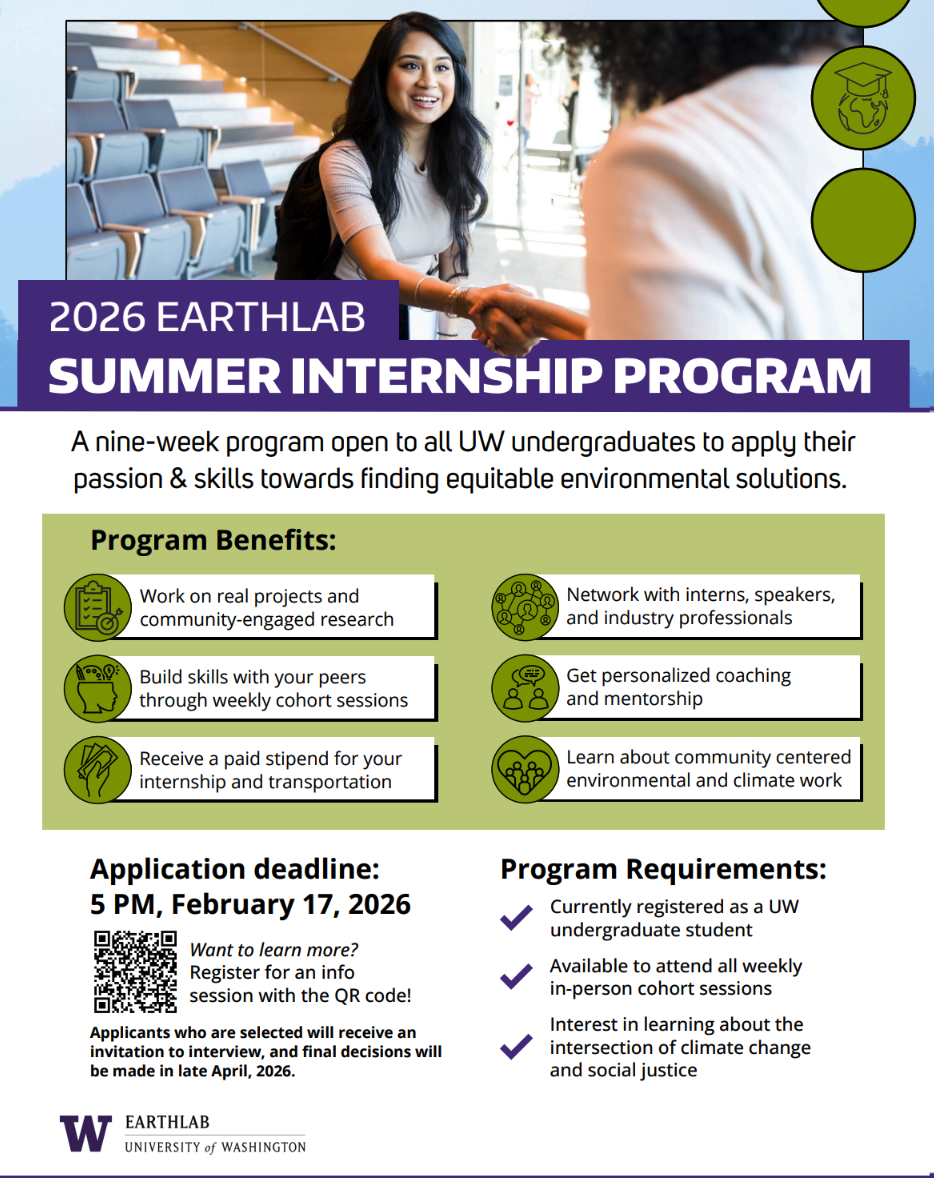
Image of the 2026 summer internship flyerA nine-week program open to all UW undergraduates to apply their passion and skills towards finding equitable environmental solutions.

EarthLab summer internships offer a robust, cohort-based experience for University of Washington undergraduate students. Undergraduate students currently enrolled as of Spring Quarter 2026 in a degree-granting program at any UW campus (Bothell, Seattle, or Tacoma) from a variety of disciplines are encouraged to apply. These paid 9-week internships will engage students in interdisciplinary and community-engaged research projects and will cover a variety of subjects. Interns will be provided professional development training and mentorship throughout.

Please note: The EarthLab Summer Internship Program will take place between June 22, 2026 – August 21, 2026. To fully participate in this program, interns will need to commit to all in-person required activities and events for the duration of the 9-week summer program. While internships vary between in-person, hybrid, and remote schedules, interns are expected to attend in-person cohort meetings every Tuesday at the EarthLab office. Additionally, interns are required to attend the final showcase presentation on August 21st.

Learn more

Program Benefits:

  • Work on real projects and community-engaged research
  • Build skills with your peers through weekly cohort sessions
  • Receive a paid stipend for your internship and transportation
  • Network with interns, speakers, and industry professionals
  • Ge personalized coaching and mentorship
  • Learn about community centered environmental and climate work

Program Requirements:

  • Currently registered as a UW undergraduate student
  • Available to attend all weekly in-person cohort sessions
  • Interest in learning about the intersection of climate change and social justice

Apply by 5 PM, February 17, 2026

Please note: Applicants who are selected will receive an invitation to interview, and final decisions will be made in late April, 2026.

Apply now


Applying for the Research Fellowship Program


Food Waste to Fuel: The Biodigester Project in South Park


An Anchor Through Shifting Tides: Annual Community Dinners Foster Connection, Collaboration for Nature and Health


EarthLab Releases Second Annual Impact Report, Highlighting Community-Led Climate Solutions and Resilience

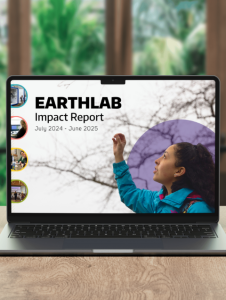
Mock up of the cover of the FY 2025 Impact Report on a computer screen with greenery in the background.SEATTLE, WA – November 13, 2025

The University of Washington’s EarthLab released its second annual impact report today, documenting fiscal year 2025 achievements in community-centered environmental research and action. The report highlights how trust-based partnerships are driving climate solutions across Washington state.

“This past year has reminded me that everything we do begins with trust,” said Phil Levin, Interim Executive Director of EarthLab. “Trust is what makes progress possible — not just in science, but in community, and in one another. In a time when so many are questioning institutions and struggling to believe that collective progress is still possible, I’ve seen how powerful it can be when people choose to trust — to stay in conversation, to share power, and to build solutions together.”

Read the full impact report here (PDF)

Key Highlights from Fiscal Year 2025 (July 1, 2024-June 30, 2025):

Training and Mentoring Tomorrow’s Climate Leaders

EarthLab’s Summer Internship Program continues to see strong demand among UW undergraduate applicants, with a roughly 5% acceptance rate reflecting significant student interest in hands-on climate justice work. In partnership with the Program on the Environment, EarthLab co-sponsored an environmental justice seminar that consistently fills the classroom with students.

EarthLab also expanded NextGen Narratives, a blog series written by and for UW students exploring what equitable climate action and hope can look like. Students pitch story ideas, work with professional editors, and publish their perspectives to over 23,000 newsletter subscribers — building valuable portfolio pieces while amplifying diverse voices on climate futures.

Read our NextGen Narratives series here

Investing in Research Co-Created with Community

After five years of the Innovation Grants Program — which has awarded nearly $2M to 29 teams — EarthLab conducted a comprehensive program evaluation to inform its future direction. 

In early 2026, EarthLab will launch two new funding opportunities designed to meet different needs and timescales, enabling the organization to support both deep relationship building and rapid responses to urgent environmental challenges.

This year’s Innovation Grants Program case study highlights the Coastlines – Camera – Action project in North Cove, Washington. Following community-led restoration of 1.1 miles of shoreline by the Shoalwater Bay Indian Tribe, Willapa Erosion Control Action Now (WECAN), and Wash Away No More, UW researchers and North Cove community members received a 2023 EarthLab Innovation Grant to enhance monitoring systems and amplify resident voices in coastal research. The grant upgraded photo monitoring stations, and community members have since submitted over 700 photos revealing storm-by-storm changes that would otherwise be undetectable through traditional seasonal monitoring methods. The project received additional two-year funding from Washington Sea Grant in winter 2025.

Read the Coastlines – Camera – Action StoryMap here

Expanding What Is Possible for Environmental Research & Action

Like mycelium sharing resources across a forest network, EarthLab’s shared services model connects over 130 researchers and staff across multiple research centers to the university resources they need to thrive.

This infrastructure has proven essential during one of the most challenging periods for climate research funding. When research teams lost federal awards with little warning in early 2025, EarthLab’s finance and administration team helped them rapidly pivot. Becca Hart, EarthLab’s Grants Manager, worked alongside researchers to identify new funding opportunities and submit proposals within weeks, allowing vital community partnerships to continue.

Last year, EarthLab’s finance and administration team supported member organizations in submitting 23 proposals, saving researchers an estimated one to two months of work annually. That’s valuable time back that researchers can instead spend in communities, conducting fieldwork, and advancing climate solutions.

“My role is to be the bridge, or the shield, or the filter — depending on the day — between researchers and the bureaucracy of the UW, state, and federal governments,” Hart said.

EarthLab also facilitated over 45 collaborative events this year, creating spaces for researchers, policymakers, and community partners to build the relationships and trust needed for meaningful climate action.

Read the Q&A with Becca Hart here

Creating Connections at UW and in Community

EarthLab met with more than 30 groups across the UW and worked with a consultant to better understand how its summer internship program could serve both student learning and community needs.

EarthLab and its member organizations brought together more than 4,000 academics, policymakers, students and community partners tackling challenges from ocean chemistry changes to wildfire response to climate change health impacts.

Following the devastating Los Angeles wildfires in January 2025, EarthLab helped the Center for Health and the Global Environment (CHanGE) organize a two-hour hybrid event connecting L.A. area experts with Washington state practitioners. The event brought together policymakers at local, county and state levels, UW students and faculty, and community members to share lessons learned for future collaboration.

“In the aftermath of a disaster, there’s not time to develop relationships, ideas and trust,” said Dr. Nicole Errett, center director of the UW Center for Disaster Resilient Communities. “Events like these are essential to creating a foundation that will allow us to collaborate to address scientific challenges when events like these occur in Washington.”

Read former EarthLab summer intern Cordy Plymale’s blog about the event here

Looking Ahead

“Federal support for the climate and environment is shrinking, but local and regional leadership is growing,” Levin noted. “Across the Northwest and beyond, people are transforming uncertainty into action — finding new paths toward connection, justice, and care. The most meaningful progress rarely happens in isolation; it comes when people work side by side, grounded in respect, humility, and trust.”

EarthLab is doubling down on its strategic plan, renewing focus on equity, partnership, and action. We have a big vision to grow our programs and impact over the next several years. If our work resonates with you, we need your support.

Make a Gift to EarthLab

A PDF of the full impact report is available here.

If you would like the plain text version of the FY 2025 Impact Report, click here.


About EarthLab

EarthLab at the University of Washington connects researchers, communities, and students to address pressing environmental challenges through collaborative, community-centered approaches. Through its shared services model, EarthLab supports a network of research centers, manages competitive grant programs, and trains the next generation of environmental leaders. EarthLab’s work is grounded in trust, equity, and the belief that transformative solutions emerge when diverse knowledge systems and communities work together.


Q&A with EarthLab Grants Manager Becca Hart

On the profound ripple effect of administrative support across climate resilience research during difficult times

By Tess Wrobleski

Federal funding for climate research has been cut dramatically since the beginning of this year, and the federal landscape continues to be precarious. In the face of this uncertainty, Grants Manager Becca Hart and the entire EarthLab finance and administration team has stepped into a critical role in our shared services network — helping researchers rapidly pivot, find new resources, and keep vital environmental justice work alive.

We spoke with Becca about the impact of federal funding cuts on her work with member organizations, and why administrative support has profound ripple effects across climate resilience efforts, especially during difficult times.

Image of Becca Hart, EarthLab Grants Manager
Becca Hart, EarthLab Grants Manager

Describe your role in one sentence.

My role is to be the bridge, or the shield, or the filter — depending on the day — between researchers and the bureaucracy of the UW, state and federal governments.

How long have you been in this role?

I’ve been at EarthLab for three years. I started as a grants specialist for one member organization, and then became a grants manager supporting several member organizations.

How many researchers do you currently support?

I support eight principal investigators, who lead research projects, and the scientists working on their teams. The finance and administration team supported nineteen principal investigators and a total of more than 50 scientists across all of our member organizations last year.

How have EarthLab member organizations been impacted by federal funding cuts? And what does it look like to lose federal funding?

Two of our member organizations have lost federal funding since February 2025. When a team loses federal funding, they receive an email notifying them that their award is being terminated. This means the work has to stop immediately. The impact of losing funding then goes out in ripples. One member organization had to lay off two positions, which was really difficult to see and had the most immediate impact. Sadly, the termination also ended funding for our partners and collaborators, creating a setback to them continuing this work.

Beyond the funding that has been cut, there’s a lot of uncertainty. With the grants we do have, there’s a question of how long we will have them for.

How are you and the researchers you support responding to these challenges?

In the case of one member organization, just a couple weeks after their award was terminated they found another opportunity that could support components of their work. They only had one week or so to submit the proposal, so it was a bit of a “drop everything” moment to get it completed.

While they got the scientific aspects of the proposal together, my role was to get all of the administrative pieces together so the proposal could get in as quickly and smoothly as possible.

What are the administrative pieces of a proposal that you support?

There are really two areas of administrative work. One is supporting the business elements of the proposal, like the budget and budget justification. Typically, the principal investigator will put together a budget, and the finance and administration team reviews it to make sure all the calculations are correct and that their proposal aligns with the rules and policies of the UW and the funding body.

There are also more relational aspects to proposal writing. I work within the system to make sure we get all the approvals we need from the department, the dean and the Office of Sponsored Programs. Once the principal investigator has given their approval to the grant, they shouldn’t have to be part of getting approvals from these other parties, which can involve some back-and-forth.

Tell me more about what this process would look like for a principal investigator if your role didn’t exist.
In some units, investigators have to submit proposals themselves, so they need to make sure all of the compliance elements are completed. The investigators would also be involved in the back-and-forth of getting approvals for the proposal. Our role here at EarthLab takes that responsibility off their plate.

Do you have an estimate of how much time you save for researchers each year?

A simple grant proposal takes around six to eight hours on the administrative side. A more complicated proposal takes longer, sometimes more than 100 hours. It really depends on the type of proposal and how much money, partners and requirements are involved.

Last year we helped member organizations submit 23 proposals. On the whole, we probably save our researchers somewhere between one and two months of work each year on proposals alone.

Do you think this model has been particularly important in the past year?

I do think this model has been important in the last year. There are researchers at the UW who don’t have a dedicated administrative team. So they’re doing all the administrative work in addition to looking for more funding opportunities and navigating the uncertainty around funding.

At EarthLab, when there’s a funding opportunity, it’s “all hands on deck” — we get a team together to go after it. As administrative staff, I’m part of that team. The researchers can hand me things and I will take care of them; they don’t have to worry about getting things through the system and being in compliance. I hope it alleviates some of their stress and saves them time as well. Reducing their administrative burden also gives the scientists more time to spend doing their research and supporting climate action in communities.

It’s easy to blame UW for being complex or frustrating, but following all the rules is critical to the ethical stewardship of funds. It’s also important for keeping our funding, maintaining our reputation and continuing to be eligible for future funding. Having dedicated administrators means we have people who can provide another layer of security around maintaining our compliance. This is more important than ever now, while there is additional scrutiny on federal funding.

What is giving you hope for the future right now?

The researchers at our member organizations. With everything being uncertain, they are still doing this essential work and finding ways to fund it, and that’s giving me hope. I’m very happy to support their work, and I’m always excited when they come up with an opportunity they want to apply for.


EarthLab extends Strategic Plan through 2028

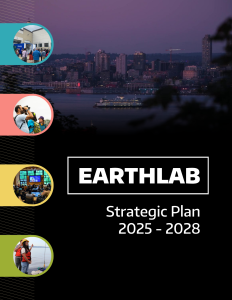
Cover of the 2025-2028 Strategic Plan
Cover of the 2025-2028 Strategic Plan. Click on the cover to read the PDF version.

EarthLab has released an updated and extended strategic plan to guide the next three years of our work. This document reflects a shared commitment aligning our diverse partners — from Tribes and nonprofits to students and faculty — around a common vision for climate action. In times of uncertainty, this roadmap helps us make decisions that honor both our mission and the communities we serve, ensuring that our efforts create lasting, equitable impact.

Our approach to climate action will continue to be organized around four action areas: creating connections at UW and in community, investing in research co-created with community, expanding what’s possible for environmental research and action, and training and mentoring tomorrow’s climate leaders. An additional priority — securing a stable funding model — remains crucial to ensuring EarthLab can deliver greater impact across all four of these action areas.

The strategic plan extension was developed collaboratively among EarthLab staff with input from our network of partners, including UW faculty, staff, researchers, and students; Tribal members and representatives; nonprofit organizations; public agencies; and community members. The plan builds on real successes: nearly $2 million in innovation grants awarded to 29 research teams, a competitive paid summer internship program that’s attracted over 950 applicants, and more than $35 million in federal grants managed while supporting member organizations across the College of the Environment and beyond.

Stay tuned for announcements in the coming months (make sure you subscribe to our newsletter) as we aim to deliver on this plan. Between re-launching an updated Grants Program that will invest in new ways to convene and respond to challenges, in addition to developing new opportunities for UW-community connections, there will be many opportunities to get involved.

With the support of our interim executive director bringing a fresh approach to the work, an experienced leadership team and core team dedicated to the cause, and passionate supporters like you making this work possible, we’re hopeful for the future of EarthLab, for a future where people and planet thrive.

Learn more and download the plan.