By Meg Parent
Conservation Science Intern, Summer 2026
Puzzles have always made sense to me. Grouping the pieces first by edge and non-edge, and then by color or pattern, and then eventually fitting them all together to create one big picture. Each piece fits nicely in the palm of my hand, with just a few identifying colors or shapes, seemingly insignificant until it fits into place.
I have realized that environmental work is a lot like that.
I tend to have the same conversation when I tell someone I’ve just met that I am studying environmental science. They smile and say, “Oh great! You’re going to solve climate change!” And I nod enthusiastically, not showing that they have placed the burden of one of the world’s greatest challenges squarely on my shoulders.
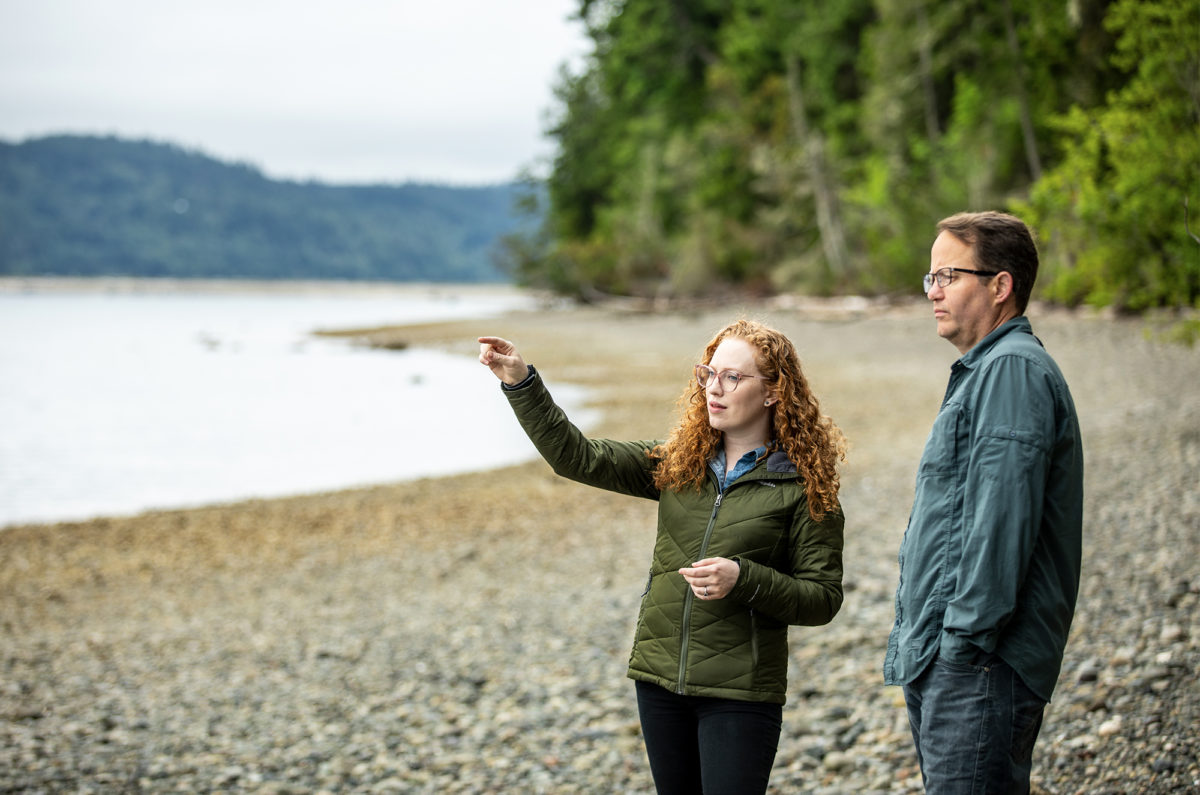
This summer, in my position as a Conservation Science Intern with The Nature Conservancy and UW EarthLab, I have spent a lot of time at the Port Susan Bay Preserve, a four thousand acre estuary in Stanwood, Washington. I have been tromping around in the wetlands, carefully collecting data about the plants, fish, birds, and bugs of the Stillaguamish River basin. Some days that meant zooming around on a boat, netting and measuring fish, and other days it meant kneeling in the mud, trying to distinguish one bulrush from another.
For a few field days, we had the additional challenge of canoeing to the transects we were surveying. We built these contraptions on the backs of the canoes to hold small kayak motors that powered us against the strong currents. When the water became too shallow, we would trudge through the mud that was so sticky it reminded me of the quicksand from The NeverEnding Story. The commute to our transects felt more like a treasure hunt.
Somewhere between the canoe rides, the fish surveys, and the days spent counting bulrushes, I realized I wasn’t just learning about restoration. I was discovering how much I loved it. I loved coming home covered in mud, with a worsening farmer’s tan, and going to sleep early to wake up the next morning and do it all over again.
When I explain this job to friends and family, they think about it the same way I think about a lone puzzle piece in my hand. Small, unrelated to the bigger picture, perhaps unimportant. They prod at me for answers, asking why exactly I am doing this, why I love it so much, or what it is for, just as I try to figure out what color grouping to put my next puzzle piece into. Sometimes I wonder the same thing. When I am sitting in a puddle, counting Schoenoplectus pungens well into the hundreds and deciphering how tall it is, I can get this feeling too. The puzzle piece feels so small, I can hardly feel it in my hand. I leave the field with pages of numbers, knowing they’ll soon be added to an ever-growing Excel spreadsheet. It’s hard to see, in that moment, covered in a mixture of marsh mud and sweat, how my effort could possibly connect to restoring an entire estuary.
The data we collect helps land managers understand how the marsh is responding to restoration. The numbers are compared across the estuary and over years of monitoring, revealing patterns that are impossible to see from a single day in the field. Those findings guide future restoration efforts and help land managers adapt restoration plans to changing conditions. In turn, those restoration efforts improve habitat for salmon and countless other species, protect culturally significant Tribal lands and traditional uses, reduce flood risk and coastal erosion for nearby communities, and restore the natural flow of water through the estuary. I blink, and suddenly my puzzle piece is connected to a quarter of the puzzle, and the picture is beginning to show.
Once I started seeing how my work fit into the bigger picture, I took closer notice of everyone else’s pieces too.
Every single environmental career is a puzzle piece. The image is progress toward environmental justice, toward mitigating climate change. Some pieces look like muddy chest waders and marsh vegetation surveys. Others look like writing policy, teaching kids, creating maps, engineering new technology, communicating science, organizing communities, gathering funds, or restoring habitat. On their own, they can seem disconnected and small, even looking like they don’t belong in the same puzzle at all. But every piece is shaped to connect with another.
I can begin to see the final picture when I meet with the EarthLab Cohort every Tuesday. I am inspired not only by how passionate everyone is about environmental justice, but also by how different everyone is. Everyone has their own interest, their own skills, their own background, and their own internship, but we come together to learn, and work through problems together. One intern is conducting interviews on collaborative governance to produce a documentary, and others are adapting environmental justice concepts into lesson plans for young kids. Listening to everyone passionately share their projects each week has become one of my favorite parts of the internship. None of our roles look the same, but we are all working toward the same goal. Being surrounded by so many different approaches to climate work has reminded me that there isn’t one right way to make a difference.
No one can solve climate change alone. Environmental progress is built from thousands of individual contributions. The next time someone tells me I’m going to solve climate change, I’ll probably smile and nod the same way I always do. But if they stick around long enough, I hope they’ll realize that’s never been the point. I’m going to count bulrushes, measure fish, watch birds, and contribute one small piece to a puzzle that is much larger than me. The picture is far from finished, but I’m grateful to know exactly where my piece belongs.